9 Best Inverter Battery Brands in India (2026)

Quick Answer
Luminous is the best all-round inverter battery brand for most Indian homes in terms of service reach. Exide suits long outages, Amaron hot regions, and Livguard or Microtek tight budgets. A 150Ah tall tubular battery costs ₹11,000 to ₹16,000 in 2026. Two things buyers misread: a “66-month warranty” is usually 48 months full replacement plus 18 months pro rata, and a 150Ah battery gives about 1,150Wh usable, not 1,800Wh, roughly 3.8 hours on lights, fans and a TV. Buy through CashKaro on Amazon, Flipkart or Croma to earn Cashback.
An inverter battery is bought once every five to seven years, usually in a hurry, and almost always on two numbers that do not mean what people think they mean.
The capacity figure is not a backup time. The warranty figure is not a period of free replacement. Both are printed prominently, both sound straightforward, and both describe something narrower than the buyer assumes.
This guide covers the nine inverter battery brands worth considering in India, what those specifications actually deliver, and how to match a battery to your home rather than to a price tag.
5 Things to Know Before Buying an Inverter Battery
1. Check the Warranty Split
An inverter battery warranty can include both a full replacement period and a pro rata period, so the advertised warranty does not always mean free replacement for the entire term.
During the full-replacement period, an eligible failed battery is replaced without charging for the new battery. During the pro rata period, you receive only partial credit towards a replacement.
So, before buying, check:
- Total warranty period
- Full replacement period
- Pro rata period
A 60-month and a 72-month battery can sometimes offer similar full-replacement coverage, with most of the difference coming from additional pro rata months.
2. Choose Battery Capacity Based on Load and Backup Time
Amp-hour (Ah) capacity does not directly tell you how many hours of backup a battery will provide.
Backup time depends on:
- Battery capacity and voltage
- Total appliance load
- Inverter efficiency
- Usable battery capacity
- Battery condition
For example, a 150Ah, 12V battery has a theoretical capacity of 1,800Wh, but the usable energy will be lower after inverter losses and discharge limits.
A practical starting point is:
| Usage | Suggested Capacity |
| Lights and fans | 100Ah–120Ah |
| Lights, fans, TV and router | Around 150Ah |
| Heavier household load or refrigerator backup | Around 200Ah |
| Very long or frequent power cuts | 200Ah or consider lithium |
Always calculate capacity from your actual appliance load rather than home size alone.
3. Pick the Right Battery Type
The three common choices are flat plate, tall tubular and lithium LFP batteries.
Flat plate batteries are generally better suited to lighter use and shorter, less frequent power cuts.
Tall tubular batteries are better suited to frequent and longer power cuts because they are designed to handle repeated charge-discharge cycles.
Lithium LFP batteries generally offer higher cycle life, lower maintenance and more usable capacity, but they cost considerably more upfront.
| Battery Type | Best Suited To |
| Flat plate | Short, occasional power cuts |
| Tall tubular | Regular household backup |
| Lithium LFP | Heavy daily use, long cuts and solar setups |
For most homes with regular power cuts, a tall tubular battery is usually the more practical lead-acid option.
4. Avoid Undersizing the Battery
A smaller battery may cost less initially, but frequent deep discharge can shorten lead-acid battery life.
If your normal load is too high for the battery capacity, the battery will discharge more deeply during every power cut.
This becomes especially important if you want to run:
- Multiple fans
- Lights
- Television
- Wi-Fi router
- Refrigerator
A refrigerator can increase both the running load and starting requirement, so homes that want refrigerator backup may need a larger battery and a suitably rated inverter.
Buying the right capacity helps provide the required backup while avoiding unnecessary strain on the battery.
5. The Battery and Inverter Do Not Have to Be the Same Brand
A lead-acid inverter battery and inverter generally do not need to be from the same brand.
What matters is compatibility between:
- Battery voltage
- Inverter charging specifications
- Supported battery capacity
- Battery type
For example, a compatible 12V tubular battery can normally be used with a suitable 12V lead-acid inverter from another brand.
Lithium batteries are different. They require an inverter or charging system designed to support the battery chemistry and its charging requirements.
So, compare compatible batteries based on capacity, warranty, price and service support, rather than automatically choosing the same brand as your inverter.
List of 9 Best Inverter Batteries From Top Brands in India
The 9 Best Inverter Battery Brands in India
Luminous
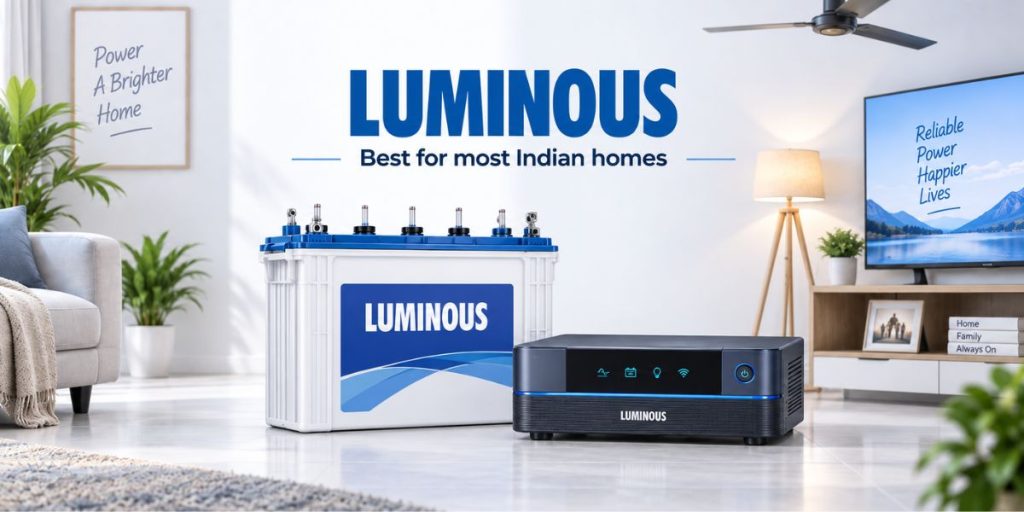
Best for: Most Indian homes and buyers who want a dependable option without comparing too many technical specifications.
| Model | Capacity | Type | Typical Price |
| EC18060 | 150Ah | Tall tubular | ₹12,000 to ₹14,500 |
| LM18075 | 150Ah | Tall tubular | ₹13,000 to ₹15,500 |
| Li-ON lithium range | Varies | LFP | ₹45,000 upwards |
What Makes It the Default Choice
Luminous is one of the most recognised inverter and battery brands in India, with a broad dealer and service network across major cities as well as many tier-two and tier-three locations. Easy access to local service can make testing, warranty claims and replacement much simpler as the battery ages.
What the EC18060 Does Well
The EC18060 is designed for relatively quick recharge and consistent backup for a standard household load such as lights, fans, a television and a router. This can be useful in areas where electricity returns only for limited periods between cuts.
Where It Falls Short
Backup time drops when heavy appliances are added continuously, which is common for a 150Ah battery rather than a Luminous-specific issue. Pricing can also sit around ₹1,000 to ₹2,000 above Livguard models of comparable capacity.
Buy Luminous If
Choose Luminous if you value broad service availability, live outside a major metro or simply want a familiar brand without spending too much time comparing plate construction and technical specifications.
Consider Another Brand If
If your power cuts regularly stretch beyond six hours and the battery is deeply discharged every day, a product built more specifically around repeated deep-cycle use may suit you better.
Exide
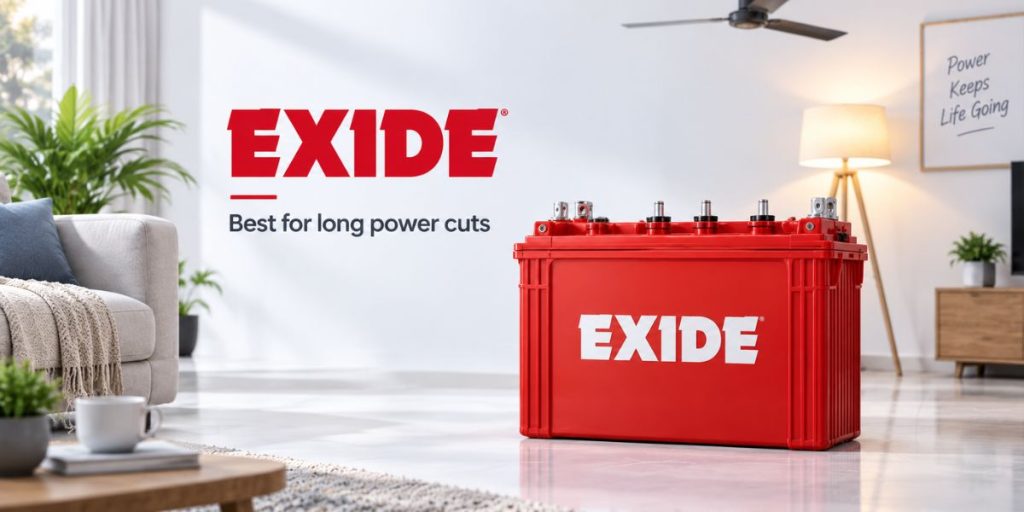
Best for: Long outages, rural areas and homes where the battery is discharged heavily and frequently.
| Model | Capacity | Warranty | What It Offers |
| InvaTubular IT500 | 150Ah | 66 months, 48 full + 18 pro rata | Torr Tubular plates, mainstream choice |
| Inva Master IMTT1500 | 150Ah | 66 months, with home service | Thickest plates in the range |
| InvaSmart ISTT1500 | 150Ah | Varies by dealer | Mid-tier tubular |
| EL Master EL150 | 150Ah | Varies by dealer | Value tubular |
Typical price band: ₹11,000 to ₹16,000 for 150Ah.
What Makes It Different
Exide’s key differentiator is its plate construction. Its Torr Tubular technology uses thick tubular plates designed to cope with repeated deep discharge and recharge cycles.
Why That Matters in Practice
A battery facing short two-hour cuts may only be partially discharged before power returns. In areas where outages stretch to six or eight hours, the same battery can be discharged much more deeply every day.
That repeated cycling places more stress on the battery, which is why thicker plates and higher electrolyte volume become more relevant in long-outage regions.
Why the Inva Master Is Worth the Step Up
The Inva Master combines the heavier-duty plate construction with home-service support. That is useful because a 150Ah battery is heavy, and home service avoids having to transport it yourself for inspection or warranty support.
Where It Falls Short
Water consumption can be higher than Amaron’s, so topping up may be required more often. The range is also relatively confusing, with several overlapping 150Ah options whose differences are not always explained clearly at the dealer level.
Buy Exide If
Choose Exide if you face long power cuts, regularly use a large portion of the battery’s capacity or want clearly published warranty terms.
Consider Another Brand If
If low maintenance is your biggest priority and your outages are not especially long, a brand designed around lower water loss may suit you better.
Amaron
Best for: Hot regions, lower maintenance and buyers who want a relatively low-maintenance ownership experience.
| Model | Capacity | Type | Typical Price |
| AR150TT | 150Ah | Tall tubular, maintenance-free | ₹13,000 to ₹14,500 |
| AR150TN54 | 150Ah | Tall tubular | ₹13,500 to ₹15,000 |
| Wider range | 100Ah to 220Ah | Tall tubular | ₹9,500 to ₹18,500 |
What Makes It Different
Amaron batteries are designed for lower water loss and reduced maintenance, which can mean less frequent topping-up than conventional lead-acid batteries. This makes them attractive to buyers who want dependable backup without frequent maintenance.
Why It Suits Hot Regions Specifically
Amaron uses a heat-resistant alloy formulation designed to perform under high operating temperatures. This makes the range particularly relevant for areas that experience long, intense summers and consistently high ambient temperatures.
The Price Question, Answered Directly
Amaron generally sits toward the premium end of the mainstream inverter-battery market. The higher price can make sense for buyers who value longer warranty coverage, lower maintenance requirements and durable construction over the lowest upfront cost.
Where It Falls Short
The main drawback is the higher purchase price compared with more budget-focused brands. Service availability can also vary by location, so checking the authorised dealer and service network in your area is important before buying.
Buy Amaron If
Choose Amaron if you live in a hot region, dislike frequent battery maintenance or are willing to pay more upfront for a lower-maintenance option.
Consider Another Brand If
If purchase price is your main concern or authorised Amaron service is difficult to access in your location, another brand may be more practical.
Livguard
Best for: Value-focused lead-acid batteries and buyers considering a move to lithium.
| Model | Capacity | Warranty | Typical Price |
| IT1560STT | 150Ah | Up to 60 months | Around ₹11,199 |
| IT1536ST | 150Ah | Up to 54 months | ₹10,500 to ₹12,000 |
| IT2042TT | 200Ah | Up to 60 months | ₹15,000 to ₹17,000 |
| Lithium LFP range | Varies | Up to 10 years | ₹45,000 upwards |
What Makes It Different
Livguard positions itself as a value-focused alternative to established inverter battery brands, offering competitive warranty terms and tubular battery options at comparatively accessible prices.
Why Its Lithium Range Stands Out
Livguard also offers lithium LFP backup solutions alongside its conventional tubular range. This gives buyers considering lithium the option of buying through an established Indian battery and inverter brand rather than relying only on lesser-known imported products.
Its dealer network also gives buyers a more familiar service route when moving from lead-acid to lithium.
The Price Question, Answered Directly
Livguard generally competes aggressively on price. Its 150Ah and 200Ah batteries can cost less than comparable options from some older premium brands while still offering long warranty periods.
That makes it particularly attractive to buyers who want strong specifications without paying primarily for brand heritage.
Where It Falls Short
Livguard has a shorter track record in the inverter-battery category than Exide, Luminous or Amaron. For a product buyers may expect to keep for five or six years, that shorter history can matter to those who prioritise long-term brand familiarity.
Buy Livguard If
Choose Livguard if you want strong value from a lead-acid battery or are considering lithium and want established Indian service support behind the product.
Consider Another Brand If
If decades of brand history and long-term market presence matter more to you than upfront value, an older brand may feel like the safer choice.
Microtek
Best for: Buyers who want to keep the upfront cost low without moving to an unknown brand.
| Model | Capacity | Type | Typical Price |
| EB1900TT | 150Ah | Tall tubular | ₹9,500 to ₹11,500 |
| MtekPower 150Ah | 150Ah | Tall tubular | ₹9,000 to ₹11,000 |
| Flat plate range | 100Ah to 150Ah | Flat plate | ₹8,000 upwards |
Warranty terms: Up to around 36 months on the models covered here.
What Makes It Different
Microtek’s strength is its value positioning. The company is already well known for inverters, and its batteries are priced to appeal to buyers who want a complete backup setup without moving into premium battery pricing.
Who It Genuinely Suits
Microtek makes the most sense for homes or small shops with moderate loads such as lights, fans and a television, especially where power cuts usually last only a few hours.
In that usage pattern, paying extra for features designed around very deep and repeated discharge may not provide much practical benefit.
The Price Question, Answered Directly
Microtek is generally positioned below the premium brands on price. This makes it useful when upfront budget is the main constraint and the expected load is moderate.
Where It Falls Short
Warranty coverage can be shorter than the 60- to 72-month headline terms available from some higher-priced competitors. That means buyers planning to keep the battery for five years or more may spend part of the ownership period outside warranty coverage.
Its service reach can also be narrower in some locations.
Buy Microtek If
Choose Microtek if budget is the main constraint, your outages are relatively short or you already use a Microtek inverter and prefer dealing with one brand or dealer.
Consider Another Brand If
Look elsewhere if you want longer warranty coverage or regularly face deep discharge because of long power cuts.
V-Guard
Best for: Areas where electricity returns for short periods between repeated cuts.
| Model | Capacity | Type |
| VT 160 | 160Ah | Tall tubular |
| Wider tubular range | 100Ah to 200Ah | Tall tubular |
What Makes It Different
V-Guard places particular emphasis on recharge performance. This makes the range relevant in areas where power may return briefly between outages rather than staying available long enough for a slow recharge.
Why Recharge Speed Matters
A larger battery is useful only if it gets enough time to recharge.
If electricity returns for two or three hours before the next cut, a battery that recharges more effectively during that window may provide better practical backup than simply choosing a larger capacity that remains partly discharged.
How to Tell If This Describes You
If your battery is frequently still partly discharged when the next power cut begins, the problem may be charging time rather than capacity alone.
In that situation, simply moving from 150Ah to 200Ah may not solve the underlying issue.
Where It Falls Short
V-Guard’s service presence is strongest in South India and may be thinner in some northern markets. Detailed plate specifications can also be less prominently communicated than those of some competing battery brands.
Buy V-Guard If
Choose V-Guard if your electricity supply tends to return in short windows between cuts or you live in an area where the brand has particularly strong dealer and service coverage.
Consider Another Brand If
If your home gets long, stable charging periods between outages, battery capacity and deep-cycle construction may matter more than rapid recharge.
Okaya
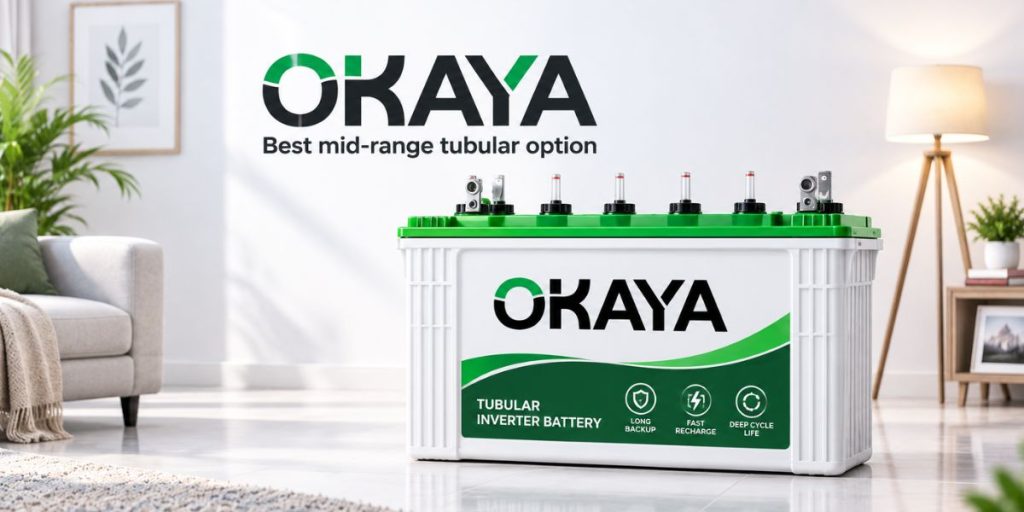
Best for: Buyers who want tubular construction at a mid-range price.
| Model | Capacity | Type |
| Hadi Tall Tubular OPHT18060 | 150Ah | Tall tubular, deep cycle |
| Wider range | 100Ah to 200Ah | Tall tubular |
What Makes It Different
Okaya’s main strength is its focus on battery manufacturing and tubular designs rather than treating batteries simply as an add-on to an inverter range.
Its lineup is built heavily around tubular and deep-cycle options.
Where It Fits in the Market
Okaya sits between budget-focused brands and the more expensive established names.
For buyers who have already decided they want a tubular battery but find Exide or Amaron expensive, Okaya can provide a middle-ground option.
The Price Question, Answered Directly
The brand’s appeal is getting tubular and deep-cycle construction without paying the full premium associated with some older brands.
That makes it particularly relevant to value-conscious buyers who still want a battery designed for regular inverter use.
Where It Falls Short
Service reach can be narrower than Luminous or Exide. Since an inverter battery may remain in use for several years, checking whether there is an authorised dealer or service point nearby is important before buying.
Buy Okaya If
Choose Okaya if you want tubular deep-cycle construction at a mid-range price and have confirmed good service availability in your area.
Consider Another Brand If
If you live far from an authorised dealer or service centre, the savings may not outweigh the inconvenience of handling a future warranty claim.
Genus
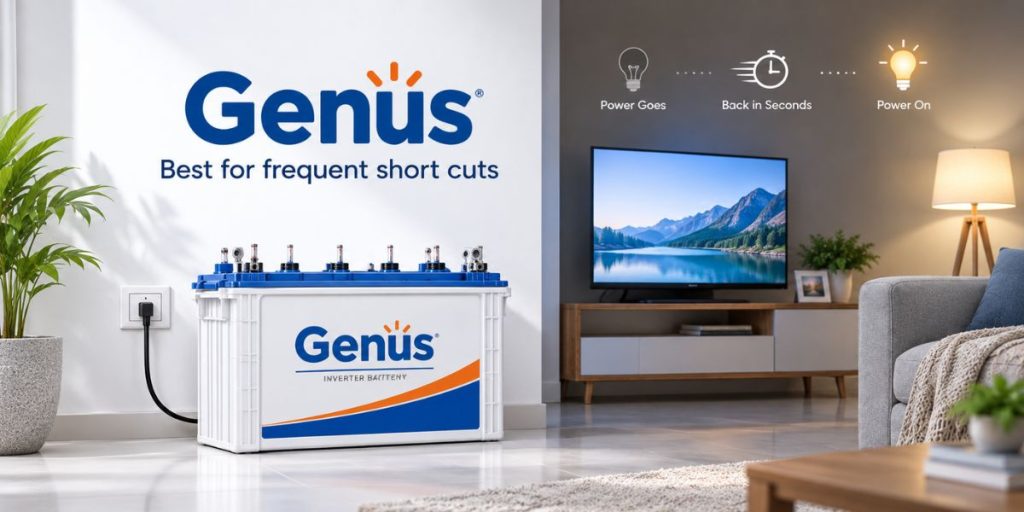
Best for: Homes that experience many short power cuts throughout the day rather than one long outage.
What Makes It Different
Genus focuses on the combination of fast charging and deep-cycle capability, which is useful for homes where the battery repeatedly discharges and recharges in short intervals.
Why the Outage Pattern Matters
Six or eight short power cuts place a different kind of stress on a battery than one long outage.
In this pattern, the battery may go through several shallow discharge cycles without getting a long uninterrupted charging window in between. Faster recharge can therefore become just as important as total capacity.
How to Tell If This Describes You
If the electricity regularly goes off for 20 to 40 minutes, returns briefly and then goes out again, your home fits this usage pattern more closely than a household facing one long cut.
Where It Falls Short
Genus has a smaller brand presence and a narrower model range than the largest players. Availability can therefore depend heavily on your local dealer.
Buy Genus If
Choose Genus if your outages are frequent but relatively short and the battery needs to recover quickly between them.
Consider Another Brand If
If you usually face one long outage each day, a battery designed more specifically around repeated deep discharge may be a better fit.
SF Sonic
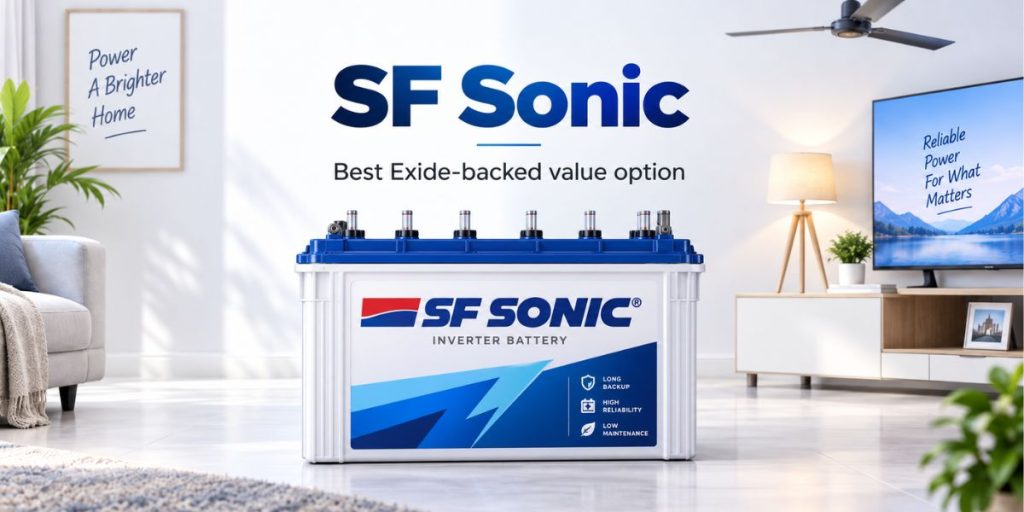
Best for: Buyers who want Exide-backed battery manufacturing at a lower price point.
What Makes It Different
SF Sonic is positioned as a value-oriented battery brand associated with Exide, giving buyers access to established manufacturing experience while targeting a more budget-conscious price segment.
Why That Matters
Buying at the lower end of the battery market can sometimes mean choosing a less familiar manufacturer with limited service infrastructure.
SF Sonic offers an alternative for buyers who want lower pricing while still buying from a brand linked to a major battery manufacturer.
Where It Fits in the Market
SF Sonic makes the most sense for moderate household backup requirements where buyers want recognised manufacturing backing but do not need the highest-end plate construction or longest warranty available in Exide’s flagship ranges.
Where It Falls Short
The value range does not necessarily match Exide’s premium Inva products on plate specifications or warranty terms.
If your home regularly puts the battery through deep discharge because of long outages, the higher-tier Exide products may offer features more specifically suited to that use.
Buy SF Sonic If
Choose SF Sonic if you want budget-oriented pricing with the reassurance of an established battery company behind the brand and your outages are moderate.
Consider Another Brand If
If you specifically want Exide’s heavier-duty plate construction or longest warranty options, it makes more sense to move up to the relevant Inva range.
Which Inverter Battery Brand Should You Choose?
| If This Describes You | Choose | Why |
| Want the safest all-round choice. | Luminous | Widest service network in India |
| Long outages, rural area, deep discharge | Exide | Thickest plates, 66-month warranty with clear split |
| Hot region, want minimum maintenance. | Amaron | Lowest water consumption, best claim experience |
| Want the best value in lead-acid | Livguard | 150Ah around ₹11,199 with 60-month cover |
| Tight budget, short outages | Microtek | Lowest prices, adequate for moderate loads |
| Power returns in short windows | V-Guard | Fast recharge is the binding constraint |
| Want tubular at a mid-range price. | Okaya | Deep-cycle construction without the brand premium |
| Frequent short cuts through the day | Genus | Built for many shallow cycles plus fast charging |
| Want Exide quality at a lower price | SF Sonic | Same parent company and service network |
| Daily long cuts, going maintenance-free | Lithium LFP | From Luminous, Exide or Livguard, ₹45,000 upwards |
One rule overrides this table. Confirm there is a service centre for your chosen brand in your town before ordering, because that single factor decides more of your ownership experience than any specification here.
Making an Inverter Battery Last in Indian Conditions
Four things determine whether you get three years or seven from the same battery, and all four are within your control.
Heat is the primary enemy. Sustained temperatures above 45 degrees accelerate degradation significantly. Install the battery in a ventilated space away from direct sunlight, never in a closed cabinet, and never next to a wall that catches afternoon sun.
Top up the water on schedule. Lead-acid batteries lose water through normal operation, and running with low electrolyte permanently damages the plates. Check the level every two to three months and top up with distilled water only, never tap water, which introduces minerals that shorten life.
Clean the terminals. Corrosion at the terminals increases resistance, which reduces charging efficiency and generates heat. A periodic clean with a wire brush and a light coat of petroleum jelly prevents it.
One additional point for humid and coastal areas. Corrosion accelerates considerably in coastal humidity, so terminal maintenance needs to be done more often in Mumbai, Chennai or Kochi than in Delhi.
Where to Buy Inverter Batteries and Earn Cashback
Inverter batteries are unusual in that a large share still sell through local dealers rather than online, largely because of installation, old-battery exchange and service access.
| Store | Best For |
| Amazon | Comparing models and warranty terms across brands before visiting a dealer |
| Flipkart | Competitive pricing on mainstream 150Ah tubular models |
| Croma | Buying alongside an inverter, with installation arranged |
Compare online, then decide where to buy. Online listings publish warranty terms, capacity and model numbers clearly, which local dealers often do not. Use that to shortlist, then check whether your dealer matches the price, because a dealer who handles installation and the old-battery exchange may be worth a small premium.
Ask about the old battery. Exchange value on a dead battery is real money, typically a few thousand rupees, and it is easier to realise through a local dealer than an online order. Factor it into the comparison rather than treating the online price as final.
Installation matters more than in most categories. A battery is heavy, contains acid, and needs correct terminal connection and ventilation. If buying online, confirm whether installation is included or arranged, because doing it yourself is genuinely inadvisable.
Three things make cashback track when buying online. Check the current rate on the store page before you shop, click through from there rather than after filling your cart, and use only coupon codes listed on the store page.
Conclusion
An inverter battery is one of the few household purchases where both headline numbers mislead in the same direction, and in both cases the shortfall is roughly a third.
Once you read them correctly, the decision is small. Work out your real load, size up rather than down, ask for the warranty split, and buy from a brand with a service centre near you.
That last test is the one that decides it in practice. A battery fails in year three far more often than it fails out of the box, and at that point plate thickness matters considerably less than whether anyone within fifty kilometres will come and look at it.
FAQs
Which is the best inverter battery brand in India?
Luminous is a strong all-round option, while Exide suits long power cuts. Amaron is good for low maintenance, and Livguard and Microtek offer value options.
What does a 150Ah inverter battery cost in India?
A 150Ah tall tubular battery usually costs around ₹11,000 to ₹16,000, depending on the brand and warranty.
How long does a 150Ah battery run?
Depending on the load, a 150Ah battery can provide roughly 2 to 6 hours of backup.
What does a 66-month warranty mean?
It usually combines a full-replacement period with a pro-rata period. Check the exact warranty split before buying.
Is tubular better than flat plate?
Yes, for most homes. Tubular batteries generally last longer and handle frequent power cuts better.
Do I need the same battery and inverter brand?
No. A compatible 12V lead-acid battery can usually work with an inverter from another brand. Lithium batteries need a compatible inverter.
Should I buy 150Ah or 200Ah?
Choose 150Ah for moderate backup needs and 200Ah for heavier loads or longer power cuts.
Is a lithium inverter battery worth it?
It can be worth it for frequent, heavy use because it lasts longer and needs less maintenance, but the upfront cost is much higher.
Why Trust CashKaro Reviews?
Highly seasoned and qualified researchers at CashKaro work hard to supply you with the greatest market advice accessible online. To build a list of products you can trust, we examine numerous inverter battery brands and compare them based on a range of characteristics. We hope our recommendations of the best inverter battery brands have helped you out. We genuinely hope that this list will aid you in making an informed judgement.
Prices are subject to change*