10 Best Tempered Glass Brands in India for Ultimate Screen Protection

Quick Answer
Spigen is the best overall tempered glass brand in India in 2026, thanks to its precise fit and easy alignment tray. Ringke is best for hassle-free installation, RhinoShield for impact protection, ESR for value, and Kyosei among Indian brands for its Asahi glass and Nippa adhesive. Do not rely only on the 9H label, as it refers to pencil hardness, not the Mohs scale. For better protection, look for full-glue tempered glass with a thickness of around 0.3–0.33 mm. Branded options usually cost ₹300–₹900, and you can earn additional cashback by shopping through CashKaro.
A screen protector is one of the cheapest ways to protect the most expensive part of your phone. Replacing a smartphone display can cost several thousand rupees, while a good tempered glass costs a few hundred.
Choosing one isn’t simple, though. Amazon, Flipkart and local shops stock dozens of brands, and while some fit well and last a year, others peel or crack within weeks. This guide covers the 10 best tempered glass brands in India for 2026: what each one does best, who it suits, and where to buy it for less.
The 10 Best Tempered Glass Brands in India
Spigen
Best overall fit and finish | South Korea
The company behind it
Spigen is a South Korean accessories manufacturer and one of the most established names in phone protection globally, covering cases, screen protectors and charging accessories across Apple, Samsung, Google and OnePlus devices.
Its scale matters here because screen protectors are model-specific products. A company shipping millions of units per phone model can afford precise tooling for cutouts, which is exactly where budget brands fail.
What you get
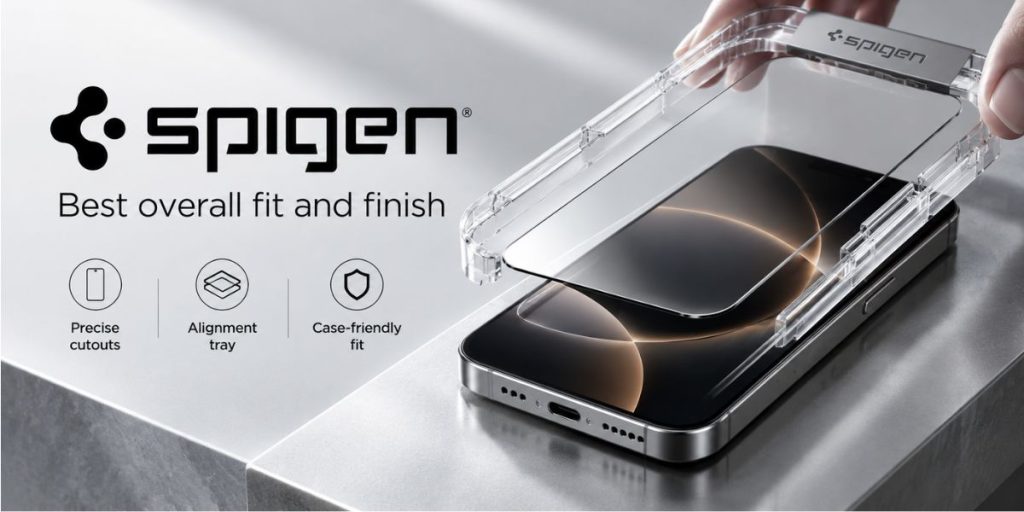
The GlasTR range is the core product, typically supplied with an alignment tray that positions the glass over the screen before you press it down.
That tray is the most underrated feature in this category. Misalignment is the most common installation failure, and it is unfixable once the adhesive bonds. A tray removes the problem entirely.
Spigen protectors carry an oleophobic coating and are cut to accommodate case lips, so a Spigen case and Spigen protector fit together without the case edge lifting the glass.
Who it suits
Anyone who has ruined a protector during installation, anyone using a case with raised edges, and anyone who wants the cutouts for the earpiece and sensors to actually line up.
What to know before buying
Spigen sits at the upper end of the mainstream price band. The glass itself is not dramatically different from good competitors. What you are paying for is the tooling precision and the installation kit.
Ringke
Best installation experience | South Korea
The company behind it
Ringke is another South Korean accessories brand, and it operates ringke.co.in as an official India storefront, which means direct sourcing rather than reliance on grey-market resellers.
What you get
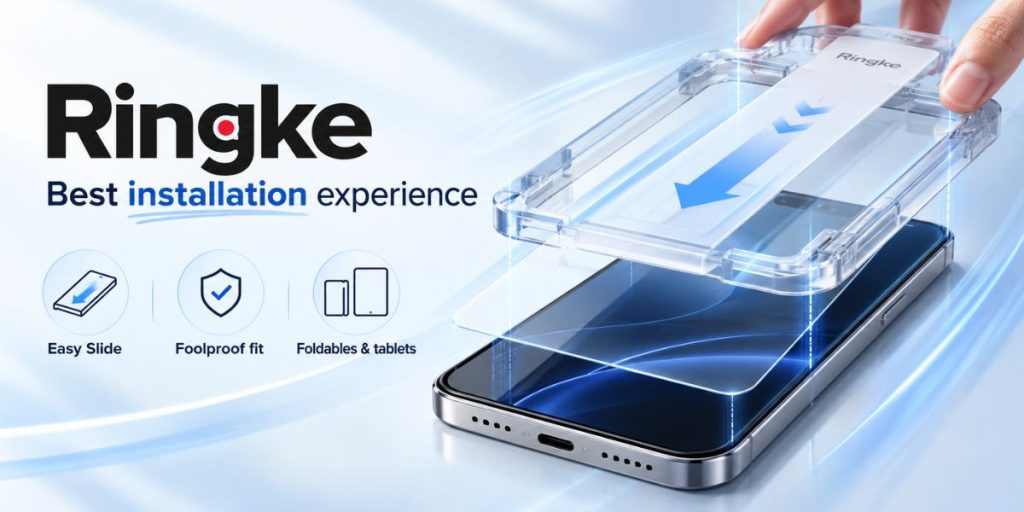
Ringke’s Easy Slide system is the differentiator. The protector comes mounted in a frame that slides into position over the phone, aligning itself so the glass lands correctly without you judging it by eye.
The range covers phones, tablets, foldables and smartwatches, including specific products for the Galaxy Z Fold series, where screen protection is genuinely difficult because of the crease and the cover display.
Ringke also sells privacy variants and anti-glare matte PET for tablets, aimed at drawing and writing rather than protection alone.
Who it suits
Anyone with a foldable, anyone buying for a tablet used with a stylus, and anyone who wants installation to be foolproof rather than merely assisted.
What to know before buying
The Easy Slide frame adds packaging bulk and cost. For a straightforward flat-screen phone, a simpler protector with an alignment tray achieves the same result for less.
RhinoShield
Best impact protection | Taiwan
The company behind it
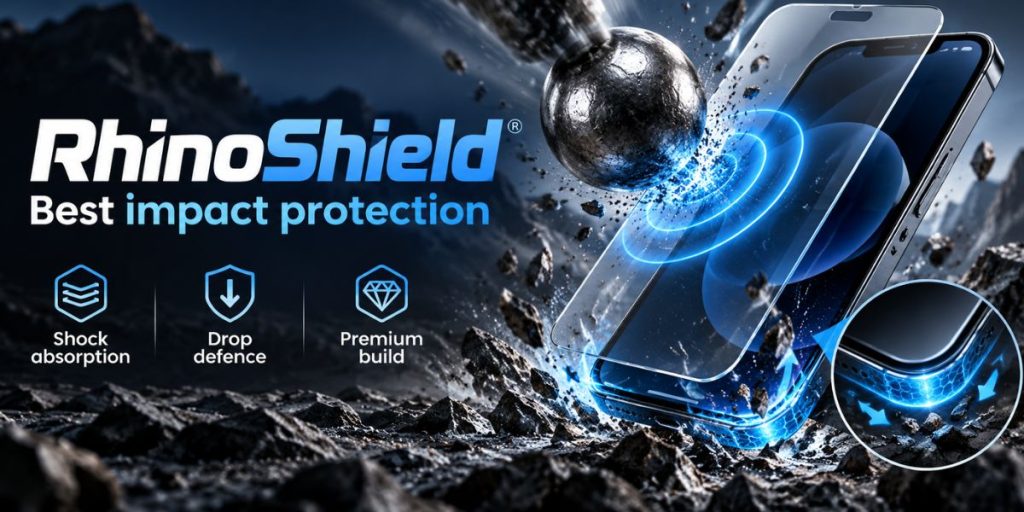
RhinoShield is a Taiwanese brand built specifically around impact absorption, and its reputation rests on drop protection rather than on scratch resistance.
What you get
Screen protection designed around the same shock-absorption principles as its cases, rather than glass sold as a commodity with a hardness number attached.
Why that distinction matters: scratch resistance and impact protection are different properties. A very hard, very thin protector resists scratches and shatters readily. A protector engineered to absorb and distribute impact force protects the screen underneath, which is what you actually bought it for.
Who it suits
Anyone who drops their phone rather than scratching it, which describes most people who have actually broken a screen, and anyone spending enough on a phone that the repair cost justifies the protector.
What to know before buying
RhinoShield is among the most expensive options here, and availability in India is narrower than Spigen’s.
ESR
Best value from an international brand
The company behind it
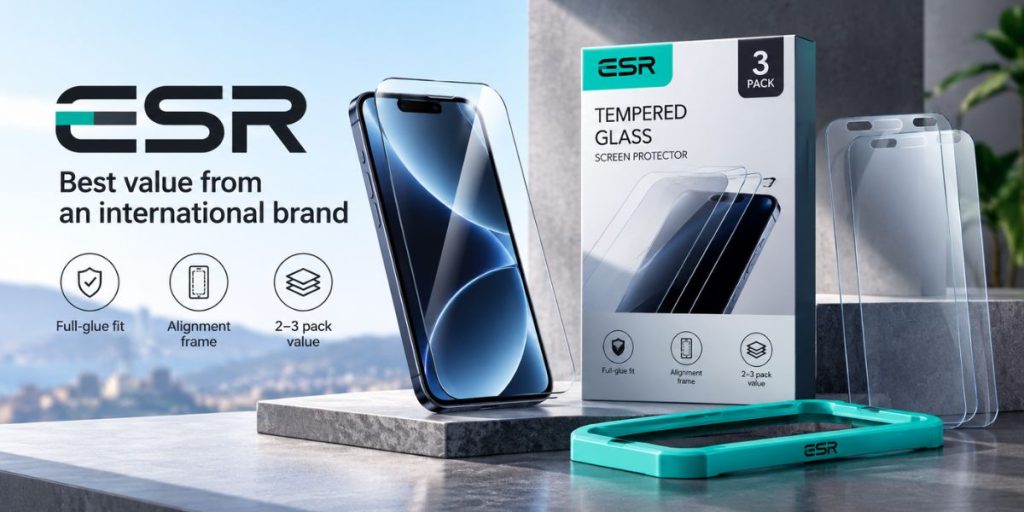
ESR is a global accessories brand covering cases, screen protectors, stands and charging products, positioned below Spigen and RhinoShield on price while competing on specification.
What you get
Full-glue tempered glass with alignment frames across most of its range, typically sold in two- or three-piece packs, which is the practical way to buy screen protectors.
Why multipacks are the sensible purchase: a screen protector is a consumable. The first one may be ruined during installation, the second cracks in a drop and does its job, and the third replaces it when the coating wears. Buying one at a time costs more per piece and leaves you unprotected while a replacement ships.
Who it suits
Anyone who wants international-brand construction at a lower price, and anyone buying for more than one phone in a household.
What to know before buying
Fit precision is good rather than exceptional. On phones with unusual sensor cutouts, Spigen’s tooling is more exact.
Kyosei
Best Indian brand on materials | India
The company behind it
Kyosei is an Indian brand producing tempered glass for smartphones, tablets, fitness bands and smartwatches.
What you get
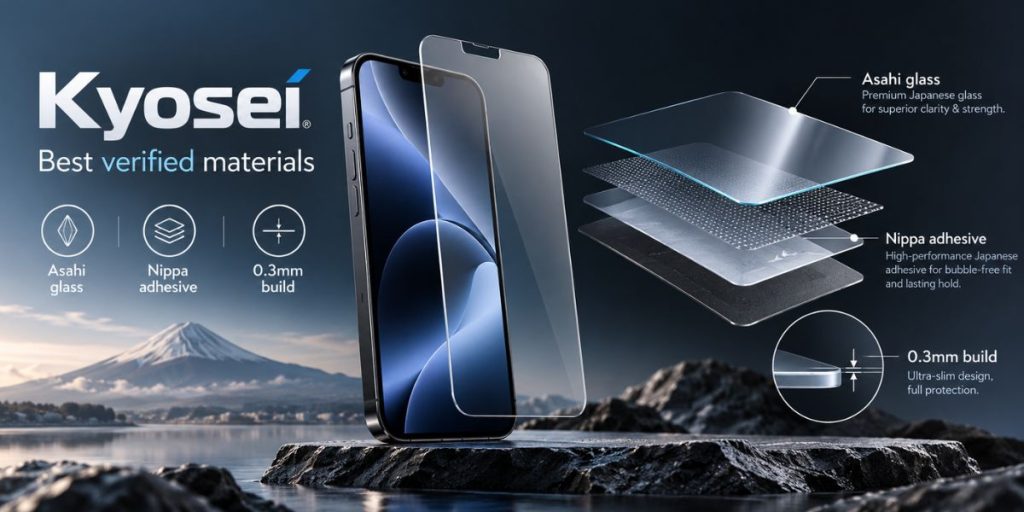
This is the specification that sets it apart. Kyosei uses polished Asahi glass factory base material and Nippa glue.
Asahi, meaning AGC, is one of the world’s major glass manufacturers, and Nippa is a Japanese adhesive maker. Most Indian protectors do not name their glass source or their adhesive at all, which usually means the answer would not help them.
Naming the base material and the glue is the clearest quality signal available in this category, because those two components determine almost everything: optical clarity, breakage behaviour and whether the protector bonds flat and stays bonded.
Kyosei claims 9H surface hardness with 99.9 per cent transparency and includes an oleophobic coating.
Who it suits
Anyone who wants verifiable materials rather than marketing language, anyone buying for a smartwatch or fitness band where the range is narrower, and anyone who prefers to buy Indian without dropping to unbranded quality.
What to know before buying
Brand recognition is lower than Korean and Taiwanese names, so you are buying on specifications rather than reputation.
Popio
Best Indian value brand | India
The company behind it
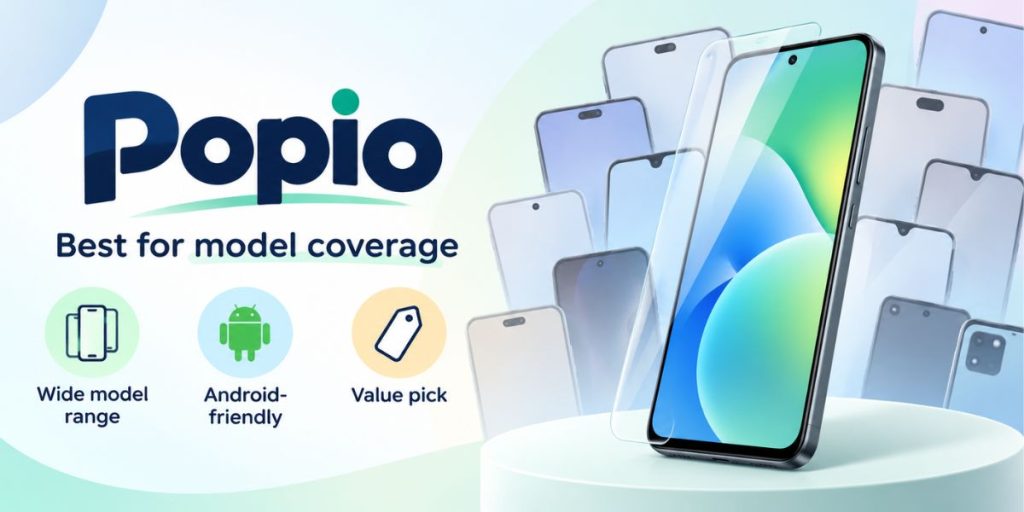
Popio is an Indian accessories brand offering screen protection across a wide range of phone models at prices below the international brands.
What you get
Tempered glass covering almost all phone models sold in India, in various thickness and clarity options, with oleophobic coating.
That model coverage is the practical advantage. Spigen and Ringke prioritise flagship and popular models. If you own a mid-range Indian-market phone that the Korean brands never tooled for, Popio probably has it, and a correctly cut protector from a mid-tier brand beats a nearly-correct one from a premium brand.
Who it suits
Owners of mid-range Android phones outside the flagship lineup, and anyone wanting a branded protector without paying international pricing.
What to know before buying
Fit precision varies more by model than with the premium brands, since the tooling investment is spread across a far larger catalogue.
amFilm
Best multipack value
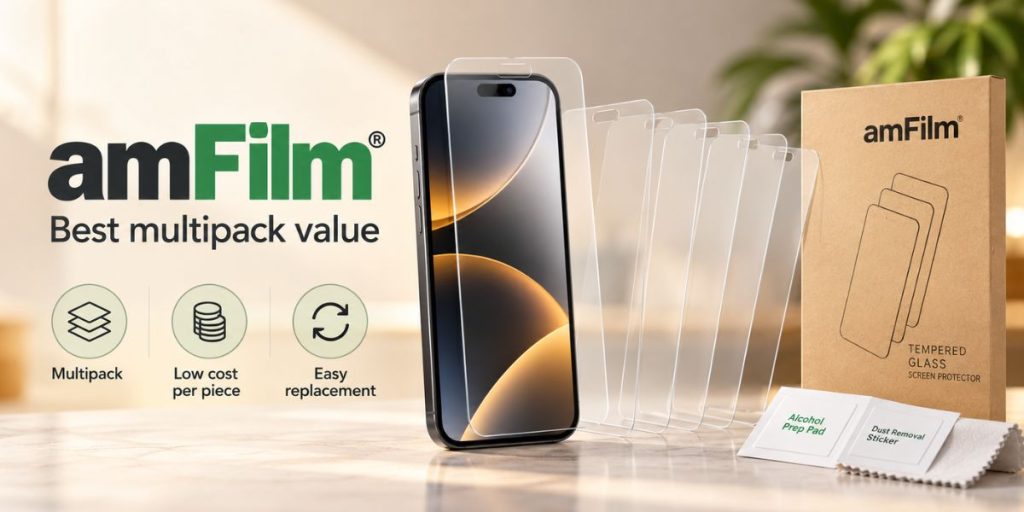
The company behind it
amFilm is an international accessories brand that competes primarily on price per piece within multipacks.
What you get
Tempered glass sold in two- and three-piece packs with installation frames, at a lower cost per protector than any of the premium brands.
Given that screen protectors are consumables replaced every 9 to 12 months, the per-piece cost across a phone’s lifespan matters more than the cost of one.
Who it suits
Anyone who replaces protectors regularly rather than keeping one until it cracks, and anyone protecting several devices.
What to know before buying
Build consistency across a multipack is the usual weak point at this price. Check each piece before applying rather than assuming they are identical.
Zagg and InvisibleShield
Best warranty | United States
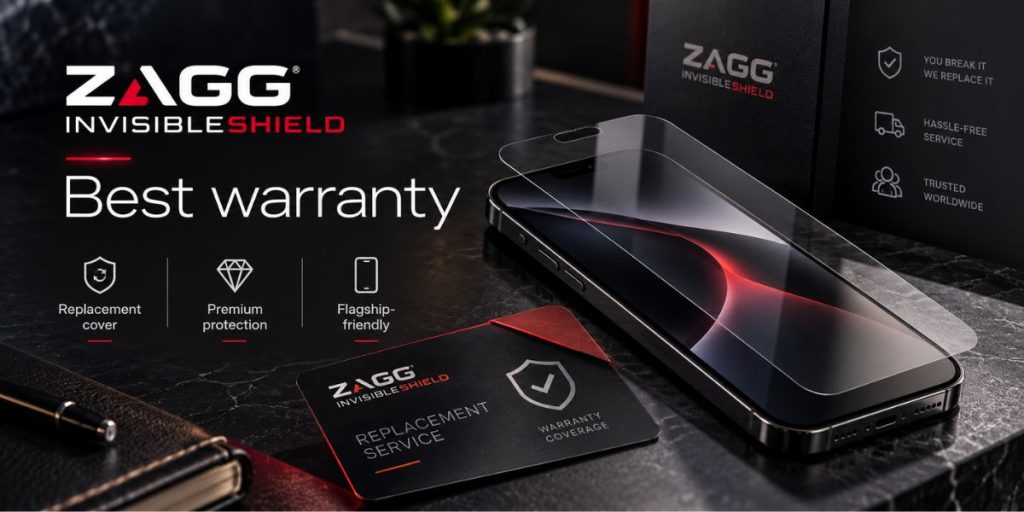
The company behind it
Zagg, which sells screen protection under the InvisibleShield name, is a US brand positioned at the premium end of the category.
What you get
The distinguishing feature is the warranty and replacement programme rather than the glass itself. InvisibleShield products have historically carried replacement coverage, which changes the economics of an item that is expected to break.
Why that is a genuine differentiator: every other brand here sells you a product designed to be sacrificed. A brand that replaces it when it does its job is selling something structurally different.
Who it suits
Anyone with an expensive phone who wants the protector treated as a service rather than a purchase, and anyone who breaks protectors frequently.
What to know before buying
It is the most expensive option in this list, and the warranty terms and claim process are worth reading before buying rather than after breaking one.
Aeidess
Best budget Indian brand | India
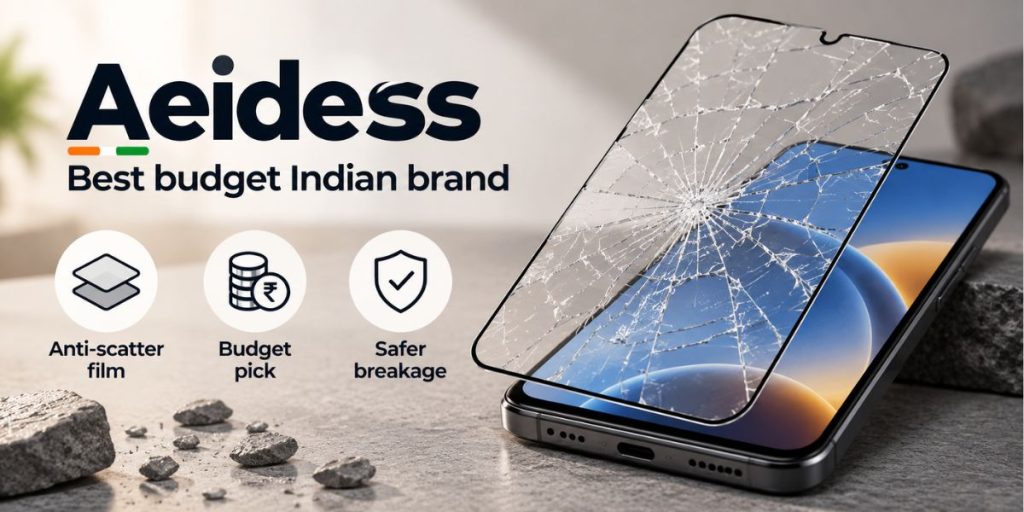
The company behind it
Aeidess is a budget-focused Indian brand emphasising durability and model customisation in tempered glass screen protectors.
What you get
Protectors are described as fortified with anti-scatter technology, which is a genuine feature rather than a marketing phrase.
What anti-scatter means. A backing film holds the fragments together when the glass breaks, so a shattered protector stays in one piece rather than leaving loose shards on the phone and in your pocket. Given that a protector’s job is to break, how it breaks is a reasonable thing to specify.
Who it suits
Budget buyers who still want a named brand, and anyone who has had a cheap protector shatter messily.
What to know before buying
Positioning is value rather than premium, so expect the glass, coating and cutout precision to reflect the price.
Stillersafe
Widely stocked Indian option | India
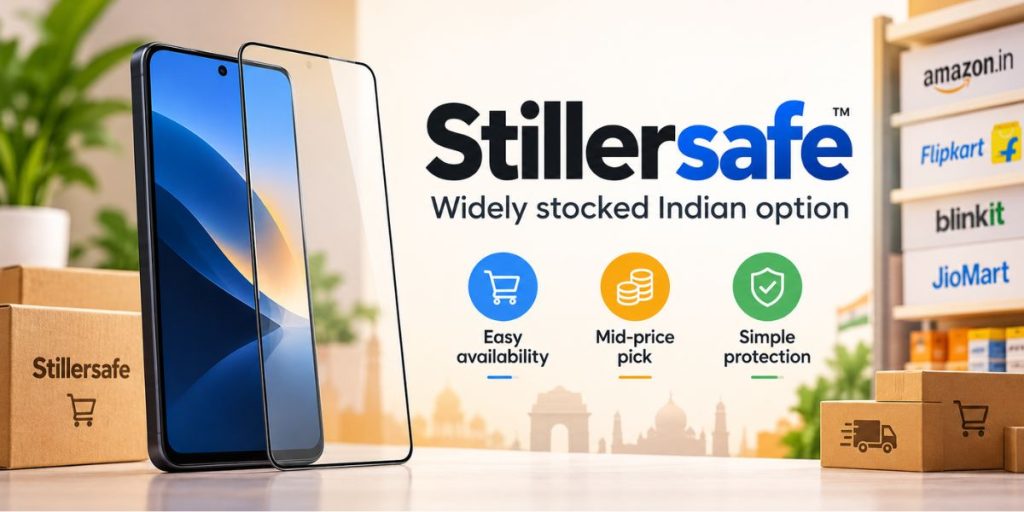
The company behind it
Stillersafe is an Indian screen protection brand that appears consistently among the better-selling options on Indian marketplaces.
What you get
Tempered glass across mainstream phone models, positioned in the mid-price band between unbranded protectors and the international names.
Who it suits
Anyone wanting a step up from unbranded glass without paying international prices, and anyone who finds it stocked for their specific model.
What to know before buying
Specifications are less clearly published than Kyosei’s, so verify the glue type and thickness on the listing rather than assuming full glue.
Tempered Glass Brands Compared
| Brand | Origin | Strongest On | Best For |
| Spigen | South Korea | Cutout precision, alignment tray | Exact fit with a case |
| Ringke | South Korea | Easy Slide installation | Foldables, tablets, foolproof fitting |
| RhinoShield | Taiwan | Impact absorption | People who drop phones |
| ESR | International | Value multipacks with frames | International build at lower cost |
| Kyosei | India | Asahi glass, Nippa glue | Verifiable materials |
| Popio | India | Widest model coverage | Mid-range Android phones |
| amFilm | International | Lowest cost per piece | Frequent replacement |
| Zagg InvisibleShield | United States | Replacement warranty | Expensive phones |
| Aeidess | India | Anti-scatter film | Budget with safer breakage |
| Stillersafe | India | Availability | Step up from unbranded |
Which Tempered Glass Should You Buy?
| If This Describes You | Choose |
| Want the most precise fit with a case | Spigen |
| Have ruined a protector during installation | Ringke, for Easy Slide |
| Own a foldable or a stylus tablet | Ringke |
| Drop your phone rather than scratch it | RhinoShield |
| Want an international build at a lower price | ESR |
| Want to know what the glass and glue actually are | Kyosei |
| Own a mid-range Android the big brands skip | Popio |
| Replace protectors two or three times a year | amFilm multipacks |
| Own an expensive phone and break protectors often | Zagg InvisibleShield |
| Buying on a budget but want safer breakage | Aeidess |
Whatever you choose, confirm two things on the listing: that it is full glue rather than edge glue, and that the thickness is stated as 0.3mm to 0.33mm. Those two matter more than the brand.
What 9H Really Means, and the Specs That Actually Matter
9H comes from the pencil hardness test (ASTM D3363). Pencil leads ranging from 6B (softest) to 9H (hardest) are drawn across the surface, and a 9H rating only means the 9H lead doesn’t scratch it. Every tempered glass sold in India prints this rating, so it can’t help you choose between them.
It is also not the Mohs scale, where tempered glass rates only 5.5–6.5:
| Mohs | Material |
| 10 | Diamond |
| 9 | Sapphire |
| 7 | Quartz (sand) |
| 5.5–6.5 | Tempered glass |
| 4.5 | Steel (keys, coins) |
Sand will scratch any protector, while keys and coins won’t, so pocket grit and dust are the real threat. Listings claiming 11D, 12H or 21D are inventing specs: pencil hardness stops at 9H, and “D” only describes curvature (2.5D is flat with rounded edges, 3D is curved).
What actually separates a ₹300 protector from a ₹60 one:
| Spec | What to Look For |
| Glue | Full glue, not edge glue. Edge glue lifts at the corners, traps dust and disrupts in-display fingerprint sensors |
| Thickness | 0.3–0.33mm, with batch tolerance within ±0.02mm |
| Oleophobic coating | Water should bead tightly on it. If water spreads, the coating has worn off |
| Edge type | 2.5D for flat screens, 3D for curved ones. Privacy glass dims the screen head-on |
Replace the protector every 9–12 months, when clarity or touch feel drops, rather than waiting for it to crack. Skip anything labelled “tempered-like,” “hardened glass” or “unbreakable,” since none of these is a real tempered glass claim.
How to Apply It Without Ruining It
- Clean in a bathroom after a hot shower. The steam settles airborne dust, which is the main cause of trapped particles under the glass. This costs nothing and works better than any included wipe.
- Use the wet wipe, then the dry cloth, then the dust sticker, in that order. The sticker is for the particles the cloth leaves behind, and skipping it is why most installations trap dust.
- Use the alignment frame if one is supplied. Misalignment cannot be corrected once the adhesive bonds, and a lifted-and-reapplied protector traps dust permanently.
- Press from the centre outwards. Small bubbles at the edges usually disappear within 24 hours as the adhesive settles. Bubbles around a trapped dust particle never will.
- Replace it every 9 to 12 months, when clarity or touch feel degrades, rather than waiting for a crack.
Where to Buy and Save
| Store | Best For |
| Amazon | Widest model coverage and multipacks, with reviews specific to your exact phone |
| Flipkart | Competitive pricing on Indian brands, deepest during Big Billion Days |
| Croma | Buying alongside a phone, often with fitting included |
Read reviews filtered to your exact model, not the product. A brand’s protector can fit one phone perfectly and another badly, because tooling is done model by model. Reviews for the iPhone version tell you nothing about the version for your Android.
Buy a two- or three-pack. You will need a replacement within a year; the per-piece cost is lower, and you are not unprotected while one ships.
Starting from CashKaro applies cashback on top of the listing discount, and since this is a purchase most people repeat once or twice a year across multiple devices in a household, it accumulates rather than saving you once.
Conclusion
Ignore the big 9H printed on the front of the box. The two specs worth checking are full glue and 0.3 mm thickness. Those are what determine whether the protector sits flat, whether the fingerprint sensor works properly, and whether the glass feels like part of the phone rather than something stuck on top of it. Most brands advertise the same 9H hardness anyway. So, when you’re comparing options, focus on the details that actually affect everyday use: full glue and 0.3 mm.
Frequently Asked Questions
Which is the best tempered glass brand in India?
It depends on what you value most. Spigen is known for precise fit and alignment trays, Ringke makes installation easier with its Easy Slide system, and RhinoShield focuses heavily on impact protection. Among Indian brands, Kyosei stands out for using materials such as Asahi glass and Nippa adhesive.
What does 9H hardness actually mean?
The 9H rating usually refers to pencil hardness, not the Mohs mineral hardness scale. It indicates resistance to scratching from a 9H pencil in a surface-hardness test. It does not mean the glass has a Mohs hardness of 9.
Is 9H tempered glass as hard as sapphire?
No. Sapphire is rated 9 on the Mohs scale, while ordinary tempered glass is much softer. The confusion comes from treating a 9H pencil-hardness rating as if it were equivalent to Mohs 9, even though the two scales measure different things.
Why does my 9H screen protector still get scratched?
Because 9H does not make a protector scratch-proof. Sand and quartz particles are hard enough to scratch glass, so grit in pockets and bags can still leave marks. Keys and coins are generally less likely to scratch glass than mineral particles.
What are 11D, 21D or 12H tempered glass protectors?
These are usually marketing terms rather than recognised technical ratings. Pencil hardness commonly tops out at 9H, while labels such as 11D or 21D are often used loosely to describe edge coverage or curvature. They should not be treated as standardised measurements.
What is the difference between full-glue and edge-glue tempered glass?
Full-glue protectors use adhesive across the entire surface, helping the glass sit evenly against the display. Edge-glue protectors attach mainly around the perimeter, which can leave an air gap beneath the centre and may cause lifting, dust buildup or fingerprint-sensor issues.