How to Save Money on Baby Products in India (2026)

Quick answer:
The biggest savings on baby products come from getting three things right: buying diapers on cost per diaper rather than pack price, not bulk-buying sizes your baby will outgrow in weeks, and separating the items where quality genuinely matters from the ones where it doesn’t. On top of that, time gear purchases to sale events and combine an eligible coupon with cashback. Note that infant formula, feeding bottles and infant foods for children under two cannot legally be discounted or promoted in India.
Baby spending has an unusual shape. A handful of one-time purchases feel expensive and get researched carefully. Meanwhile, the genuinely large number is the one nobody tracks: diapers, wipes, and clothes in sizes that last six weeks.
Work it through. A newborn goes through roughly 8 to 12 diapers a day, tapering to 5 or 6 by the end of the first year. Average that at about 7 a day and you are buying around 2,550 diapers in year one. At ₹11 each, that is over ₹28,000 on a single consumable, usually more than the cot, pram and car seat combined.
That is where the method has to be pointed. This guide covers where the money actually goes, which corners are safe to cut and which are not, and how to save money on baby products in India.
Best Ways to Save on Baby Products
Split your list into “spend” and “save”
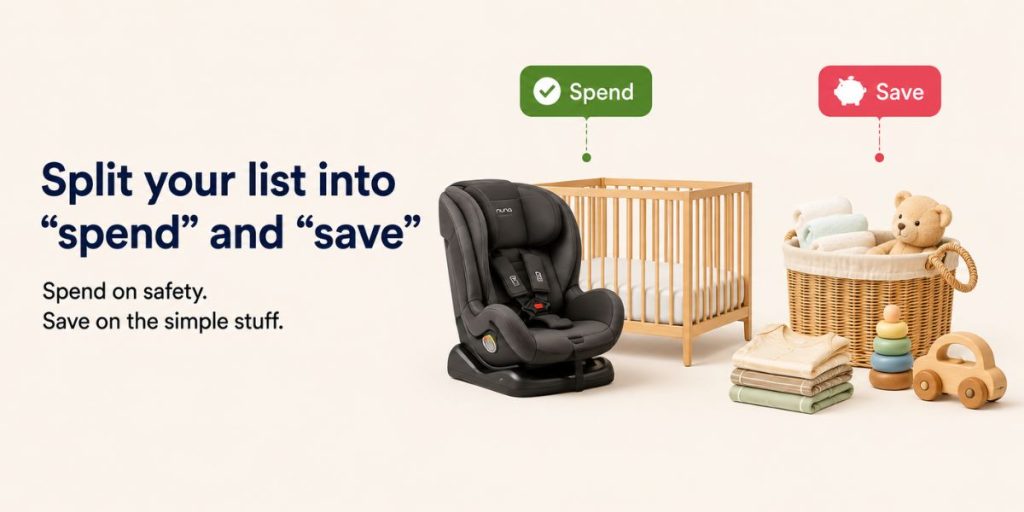
Baby products are marketed to anxiety, and anxiety is expensive. The useful discipline is deciding in advance which category each item falls into.
- Worth spending on: items where a failure has consequences: car seat, cot mattress, high chair, anything load-bearing or sleep-related.
- Safe to save on: items where the expensive version and the affordable version do the same job: clothing, blankets, towels, most toys, changing mats, storage, nursery décor, baby bath products.
- Depends entirely on use: pram, carrier, sterilisers, breast pumps, monitors. Heavy daily use justifies spending; occasional use often doesn’t justify buying at all.
Also check: If you’re looking for the best baby product brands in India, check our expert recommendations. The mentioned brands are picked after careful consideration to ensure complete safety for babies.
Buy diapers on cost per diaper
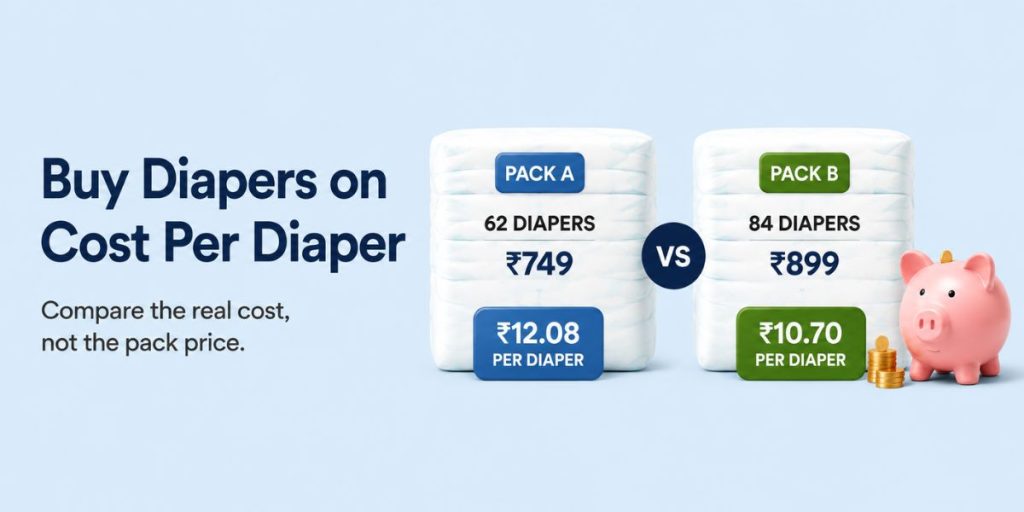
Diaper packs are sold in inconsistent counts specifically so that pack prices are hard to compare. The only number that matters is cost per diaper.
Cost per diaper = Final price paid ÷ Number of diapers in the pack
Suppose you are choosing between:
- Pack A: 62 diapers, ₹749 → ₹12.08 per diaper
- Pack B: 84 diapers, ₹899 → ₹10.70 per diaper
Pack B costs ₹150 more and looks like the bigger spend. At 7 diapers a day:
- Pack A: ₹84.56 per day
- Pack B: ₹74.90 per day
A difference of ₹9.66 a day. Over a year, that is roughly ₹3,500, from one comparison most parents never make.
Run the same calculation on wipes (cost per wipe) and formula-free consumables like nappy liners. Always use the final price after discount and coupon, since a coupon on the smaller pack can reverse the result.
One caution: cost per diaper only matters if the diaper works. A cheaper diaper that leaks means extra changes, extra washing and disrupted sleep. Test a small pack before committing to a large one.
Also read: Since babies have sensitive skin that can react to any material, check the best diaper brands you can consider.
Never bulk-buy the newborn sizes
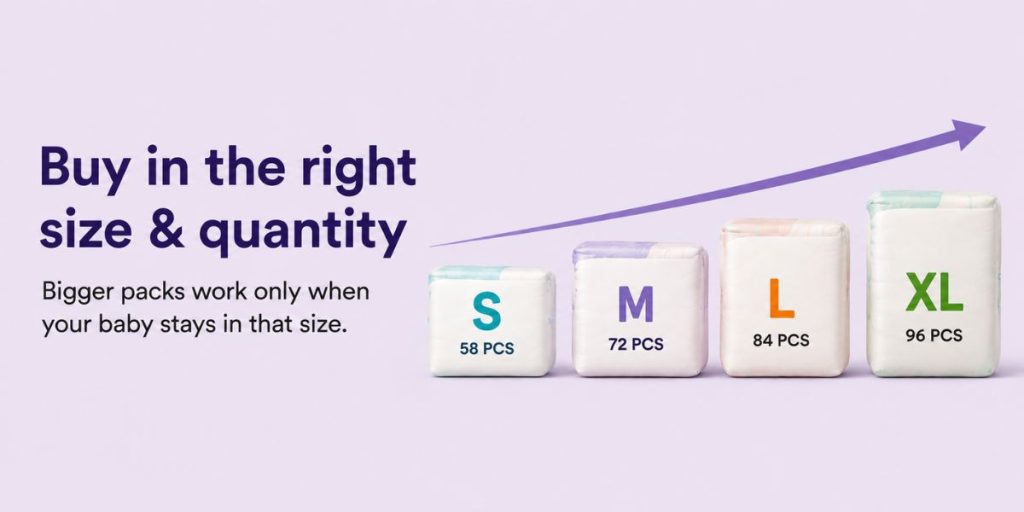
Baby products are equivalent to buying food that expires. Bulk-buying feels prudent and is usually the single most expensive mistake in the first three months.
Babies outgrow newborn and 0–3M sizing extremely quickly, commonly in four to eight weeks. If you buy three months’ supply of newborn-size diapers and your baby moves up a size at six weeks, you are left holding hundreds of diapers you cannot use.
Practical rules:
- Diaper sizes are set by weight bands, not age. Check your baby’s current weight against the pack, and check it again every couple of weeks.
- Buy no more than 2–3 weeks of the newborn size at a time. Scale up to bulk buying only from size M onwards, when babies stay in a size for months.
- The same applies to clothing. Buy minimal quantities in 0–3M; buy ahead only in 6–12M and above, and only in the coming season’s sizes.
- Unopened, sealed diaper packs can usually be exchanged or returned within the retailer’s window. Keep the packaging and the invoice until the size is confirmed.
Check the ISI mark before calling a toy a bargain
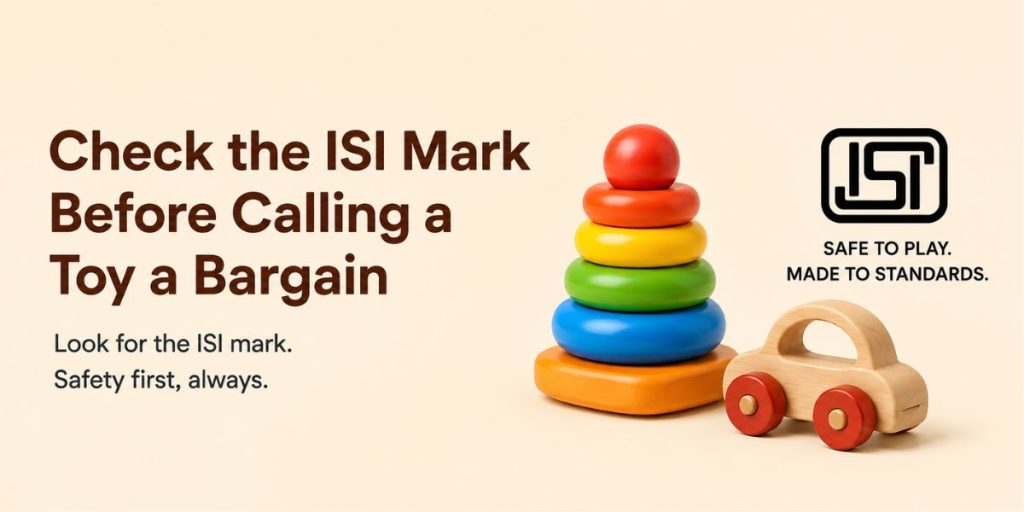
A very cheap toy is not a saving if it is illegal to sell.
Under the Toys (Quality Control) Order, 2020, toys for children aged 14 and under must conform to seven Indian Standards covering physical, chemical and electrical safety, and must carry the ISI Mark under a licence from the Bureau of Indian Standards. The order has been in force since 1 January 2021, and no person is permitted to manufacture, import, sell, distribute, store, hire, lease or exhibit for sale toys that do not conform and do not bear the mark. BIS enforcement raids have resulted in the seizure of large quantities of non-ISI-marked toys. (Source)
So, when you see a toy priced dramatically below everything comparable, treat it as a warning rather than a win. Check the listing images and the product page for the ISI mark and prefer sellers who state the standard. This applies to imported toys too; the requirement covers imports.
Buy second-hand but only in the right categories
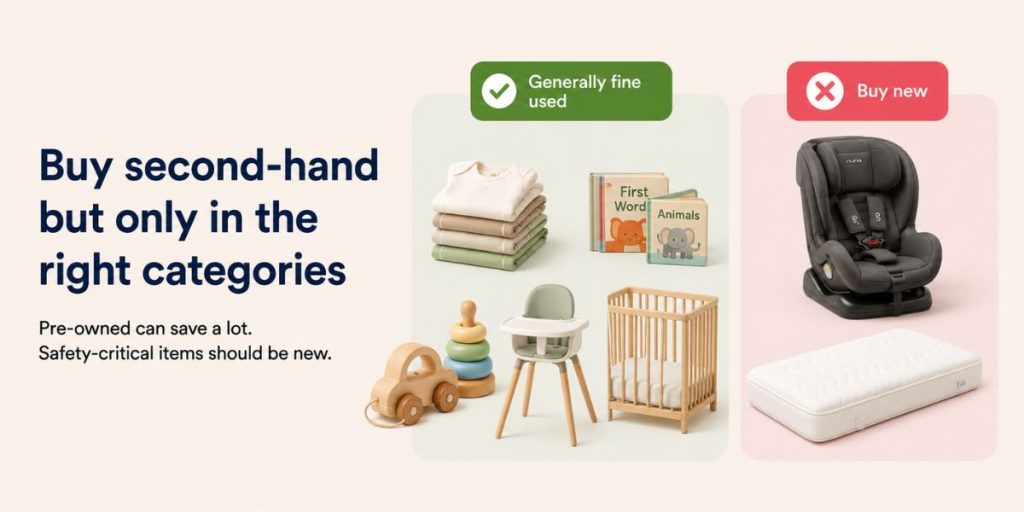
Pre-owned is the single largest saving available for gear, because most of it is barely used before being outgrown.
Generally fine used: clothing, books, toys with the ISI mark intact, wooden furniture, playpens, bath tubs, high chairs in sound condition.
Buy new: Baby car seats (impact history is invisible and they have expiry dates), cot mattresses (hygiene and firmness degrade), anything with a recall history, and any item where you cannot verify the model.
The best source is usually a local parents’ or apartment-society group, where gear circulates constantly, and you can inspect before paying. For anything you are unsure about, a bouncer, a particular carrier, or a type of pram, borrow or rent before buying.
Time gear purchases to sale windows
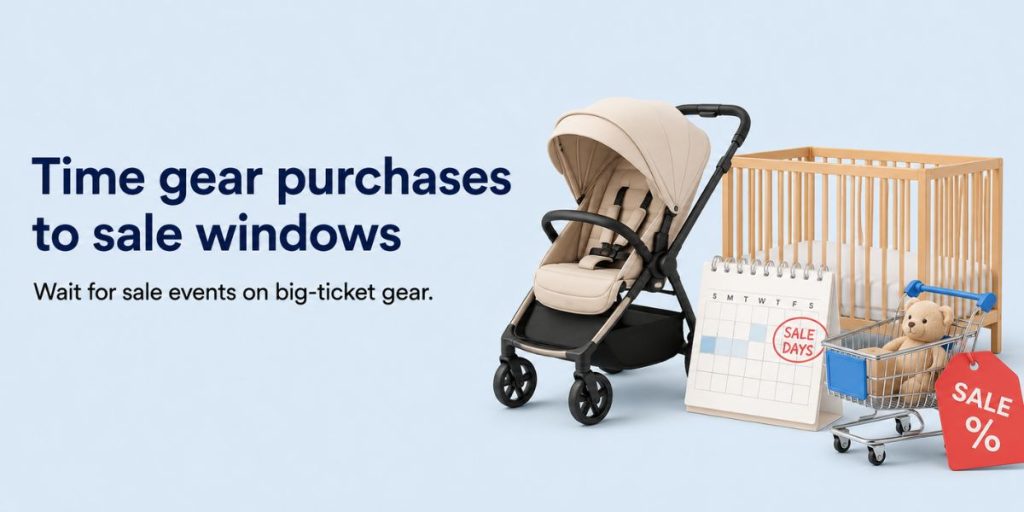
Consumables should be bought as needed. Big-ticket gear should wait.
FirstCry, Amazon, Flipkart and AJIO all run major baby and kids events throughout the year, clustered around the festive season and the large platform sales. On a ₹6,000 pram, a 30% sale price is ₹1,800 back, far more than any coupon or cashback will contribute.
Plan the predictable purchases in advance. A pram, cot or high chair is rarely needed the same day, so a list prepared before the event beats a panic purchase after. What creates last-minute full-price buying is not knowing what you will need and when.
Check the recent selling price before you buy. Baby MRPs are frequently set high enough that a large displayed discount lands close to the everyday price.
Note: Wondering when the next sale will be? Check all about upcoming sales on different platforms and plan your purchases accordingly.
Stack coupons with cashback
A coupon reduces what you pay at checkout. Cashback is credited separately after your order tracks and is confirmed. They generally work together.
Live CashKaro rates for baby and kids stores, checked August 2026:
| Store | Cashback Rate | Worth knowing |
| The Moms Co | Flat 40% Cashback on all orders | Website only, not app |
| AJIO | Up to 7% Cashback | Kids clothing and footwear |
| Baby Forest | Flat 6% Cashback on all orders | Ayurvedic baby care |
| Amazon | Up to 5% Rewards | Rewards, not cashback |
| R for Rabbit | Flat 5% Cashback on all orders | Prams, car seats, gear |
| FirstCry | ₹35 on orders over ₹500; ₹20 on ₹100–₹499 | Flat amount, website only, no bulk transactions |
Note: Rates are subject to change. Check the store page for current rates and offer terms before ordering. Coupons and cashback do not apply to infant milk substitutes, feeding bottles or infant foods for children under two.
You can compare current rates across baby and kids stores before you order.
Do not buy the full essentials list before the baby arrives
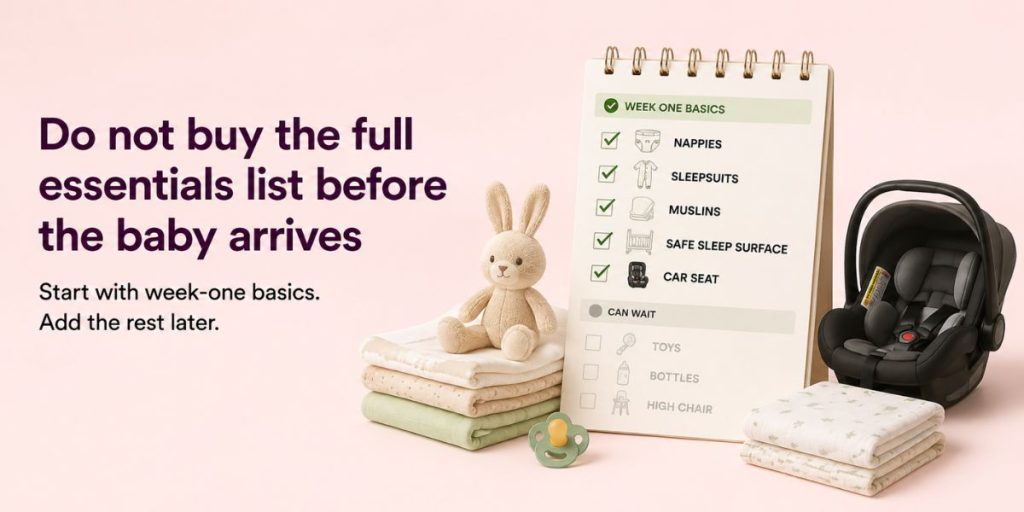
Standard newborn checklists are written to be comprehensive, not economical. They assume every baby will accept every product, and babies do not cooperate. Bottles get rejected, carriers turn out to hurt your back, swaddles get kicked off, and the bassinet goes unused because the baby will only sleep next to you.
Buy in three waves instead:
- Before birth: only what you cannot function without in week one, nappies in the smallest size, a few sleepsuits, a safe sleep surface, muslins, a car seat if you are driving home.
- Week two to three: once feeding and sleeping patterns are visible, buy the specific bottle, pump or carrier that matches how things are actually going.
- Month two onwards: everything else, only as the need appears.
The items most often bought early and never used are bottle sterilisers, bottle warmers, changing tables, shoes for pre-walking babies, and multiple carrier types. Delay all of them.
Buy clothes one size and one season ahead
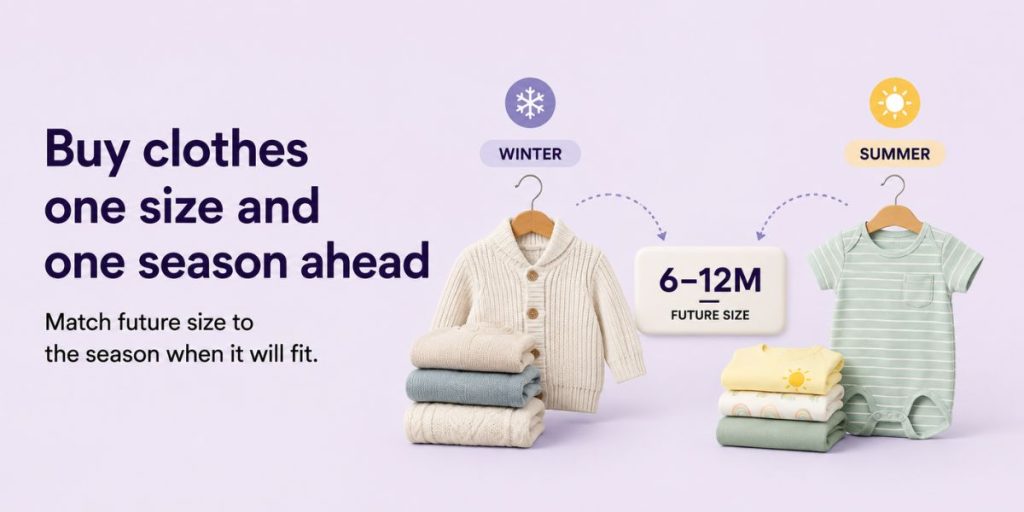
Clothing waste comes from a mismatch between size and season. A 6–12M winter jacket bought in a summer sale is only useful if your baby is 6–12M in winter.
Work backwards from the calendar:
- Note which size your baby is likely to be in each coming season, based on the current weight band.
- Buy end-of-season clearance only for the size that lines up with next year’s matching season.
- Buy the current season in the size your baby is in now, in small quantities.
Below 12 months, growth is fast enough that buying more than one size ahead is guesswork. Above 12 months it becomes reliable, and end-of-season sales get genuinely useful.
Keep clothes in gender-neutral colours and good condition if you may have another child, or if you intend to resell. Both preserve value that patterned, heavily branded pieces do not.
Stop paying the “baby” premium on things
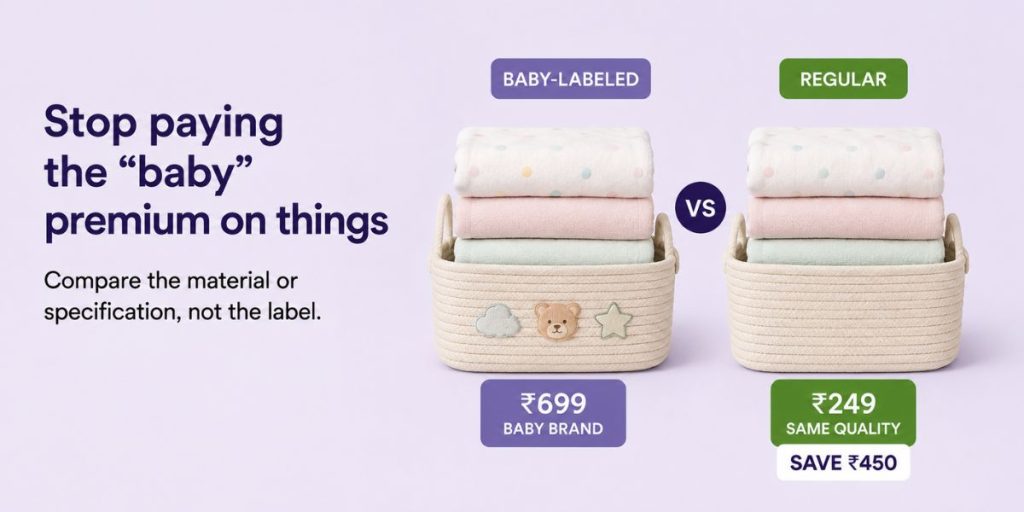
Some baby-labelled products are genuinely formulated differently. Many are the same product with different packaging and a higher price.
Usually worth the baby version: fragrance-free detergent for anyone with sensitive skin, mild cleansers formulated for infant skin, sunscreens formulated for children.
Usually just markup: storage boxes, laundry baskets, blankets, towels, feeding bibs, bath thermometers, room thermometers, and packaged “baby water”.
Before paying a premium, read the ingredient list or the specification rather than the label. If a baby-branded towel and a regular cotton towel have the same composition, you are paying for the print.
How to Stack Savings on One Baby Order
- Separate your list into consumables (buy as needed) and gear (buy in a sale).
- Check your baby’s current weight band before ordering any diaper size.
- Calculate cost per diaper or cost per wipe across the options.
- Compare prices across FirstCry, Amazon, Flipkart and the brand’s own site.
- Check the CashKaro rate at each, and note whether it is a percentage or a flat amount.
- Confirm whether cashback applies to app orders or website only.
- Start the session from CashKaro without pre-loading your cart.
- Apply an eligible coupon at checkout.
- Check for a compatible bank or payment offer.
- Complete the purchase in the same session and keep the confirmation until cashback tracks.
FAQs
How can I save money on baby products in India?
Compare diapers and wipes on cost per unit rather than pack price, avoid bulk-buying newborn sizes your baby will outgrow within weeks, buy gear second-hand or during sale events, and reserve premium spending for safety-critical items like car seats and cot mattresses. Combine an eligible coupon with cashback where available.
Is it cheaper to buy diapers in bulk?
Only from size M onwards. Larger packs usually have a lower cost per diaper, but babies move through newborn and small sizes in weeks, so a bulk pack often goes unused.
Which baby products should I not buy second-hand?
Car seats, cot mattresses, and anything with a recall history. A used car seat may have been in a collision without visible damage, and car seats carry expiry dates. Clothing, books, wooden furniture, playpens and ISI-marked toys are generally safe to buy pre-owned.
What is the 5-8-5 rule for babies?
It is a soothing method for crying infants: carry a crying baby while walking for 5 minutes, then sit and keep holding for 5–8 minutes before laying them down. Walking calms them; the sitting time lets them fall deeper asleep, so the laydown doesn’t wake them.