How to Save Money on Home Appliances in India

Quick Answer
To save money on home appliances, focus on the total cost of ownership, not just the purchase price. Compare BEE star ratings, calculate how long the extra upfront cost will take to recover through lower electricity bills, and choose the right appliance size for your needs. Also check service availability in your city, shop during major festive sales, combine eligible bank or coupon offers, and earn cashback through CashKaro. With the right combination of discounts, a ₹40,000 appliance could effectively cost around ₹28,130.
Buying home appliances can be a significant expense, especially when you are shopping for multiple products or replacing an old one. The good news is that there are several ways to reduce both the upfront cost and the amount you spend on running the appliance over time.
From choosing the right model and checking energy efficiency to comparing prices, timing your purchase, and using available offers, small decisions can add up to meaningful savings.
Here are the practical ways to save money on home appliances in India.
8 Ways to Save Money on Home Appliances
Read the BEE Star Rating Properly
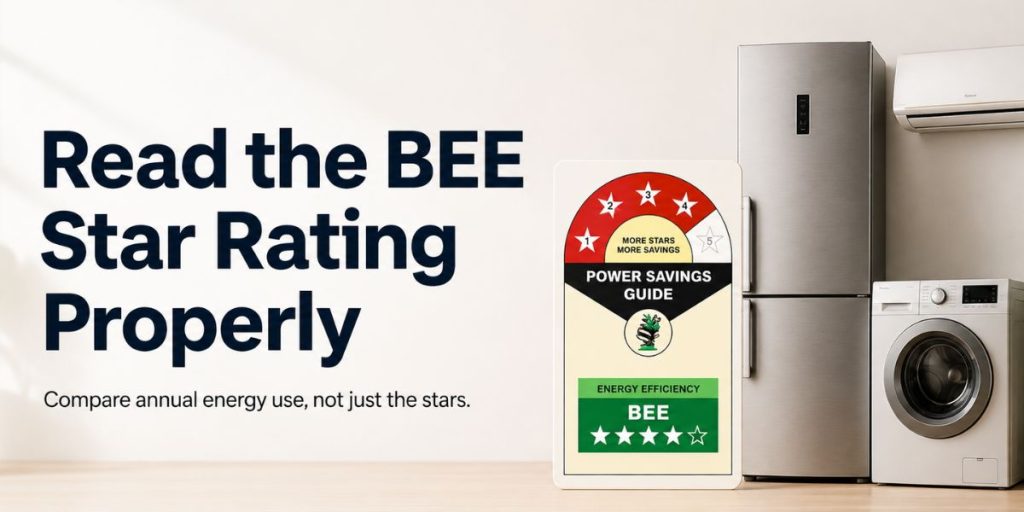
Every major appliance sold in India carries a Bureau of Energy Efficiency (BEE) label that rates its energy efficiency from one to five stars. In general, the more stars an appliance has, the less electricity it uses.
The difference in energy consumption can be significant. A higher-rated appliance may cost more upfront, but it can help reduce your electricity bills over time. That is why it is important to look beyond the star rating alone.
Two details on the BEE label are especially important:
- Annual energy consumption: The label shows how much electricity the appliance is expected to use in kilowatt-hours (kWh) per year. This is often a better figure to compare than the star rating because two appliances with the same number of stars can still have different annual energy consumption.
- Label validity period: BEE periodically updates its energy-efficiency standards. This means an older appliance may carry a star rating based on previous standards. Always check the validity period on the label to make sure you are comparing models using current criteria.
It is also worth knowing that BEE labelling requirements vary by appliance category. Some appliances fall under mandatory labelling, while others may be covered under voluntary schemes. So, the absence of a star rating does not automatically mean that an appliance is inefficient.
Once you buy the appliance, the way you use it also affects how much electricity you consume. Our guide on how to save on your electricity bill covers practical habits that can help you reduce energy costs further.
Work Out the Payback Period Before You Decide
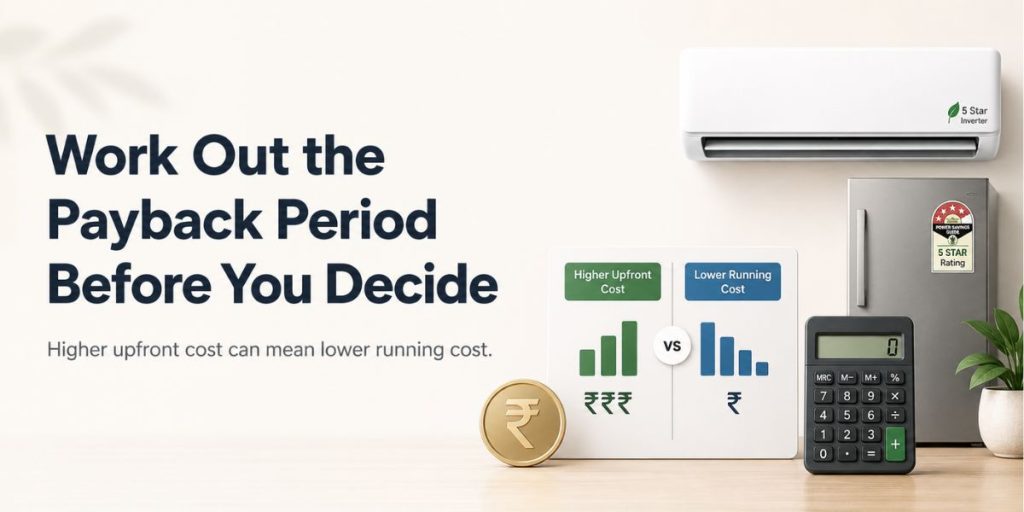
A 5-star appliance may cost more upfront, but it usually costs less to run. The important thing is to understand how long it will take for the electricity savings to recover the extra purchase cost.
You can calculate this in a few simple steps. Take the annual energy consumption shown on each BEE label and multiply it by your electricity rate per unit. This gives you the estimated yearly running cost. Then divide the extra cost of the more efficient model by the amount you save on electricity each year. The result is the payback period.
Here is an example for three common appliances, assuming an electricity rate of ₹8 per unit.
| Appliance | 5-Star vs 3-Star Annual Use | Yearly Saving | Extra Cost | Payback Period | 10-Year Saving |
| Air conditioner, 1.5 ton | 700 vs 1,100 kWh | ₹3,200 | ₹6,000 | 1.9 years | ₹26,000 |
| Washing machine | 180 vs 300 kWh | ₹960 | ₹3,000 | 3.1 years | ₹6,600 |
| Refrigerator | 250 vs 400 kWh | ₹1,200 | ₹4,000 | 3.3 years | ₹8,000 |
Air conditioners can offer particularly strong savings because they consume a significant amount of electricity. In this example, paying ₹6,000 extra for the 5-star model is recovered through lower electricity bills in less than two years, with potential savings of around ₹26,000 over ten years.
A simple rule is to prioritise energy efficiency for appliances that run for several hours a day or operate continuously, such as air conditioners and refrigerators. For appliances that are used only for short periods, such as microwave ovens or mixer grinders, the difference in electricity costs may be smaller, so factors such as build quality, features and durability may deserve more attention.
Refrigerators are a good example because they run throughout the day. Our list of the best refrigerators in India compares models based on both capacity and energy efficiency. You can also check the refrigerator offers page for available deals and cashback offers.
Buy the Right Size, Not the Biggest

Buying an appliance that is larger than you need can increase both the upfront cost and the amount you spend on electricity or water over time. The right size should depend on your household needs, not simply on choosing the biggest available model.
- Refrigerators: A 200 to 250-litre refrigerator is generally suitable for a couple, while a family of three or four may need around 250 to 350 litres. Larger families with five or more members can consider models with a capacity of 400 litres or more. Buying more capacity than you need means the refrigerator has a larger space to cool, which can increase energy consumption.
- Air conditioners: AC capacity should be chosen according to room size. As a general guide, rooms up to 120 sq. ft. may need a 1-ton AC, rooms between 120 and 180 sq. ft. may require a 1.5-ton model, and larger rooms may need a 2-ton AC. An oversized AC can cool the room too quickly and switch off before removing enough humidity, which may make the room feel cold but uncomfortable.
- Washing machines: A 6 to 6.5 kg washing machine is usually sufficient for two people, while a 7 to 8 kg machine may work better for a family of three or four. Households with five or more members can consider a 9 kg or larger model. If you regularly wash bulky items such as bedsheets and blankets, choosing a slightly larger capacity may be more practical.
Choosing an appliance that is too small can also increase costs. For example, a washing machine with insufficient capacity may require you to run multiple cycles instead of one, using more water and electricity.
For more detailed guidance, explore our air conditioner, washing machine, and refrigerator guides, which cover sizing, features, and buying considerations in greater detail.
Choose a Brand That Serves Your City

After-sales service is an important factor when buying a home appliance, especially if you plan to use it for several years. Even a reliable appliance may eventually need maintenance or repairs, so it is worth checking whether the brand has an authorised service centre in or near your city.
Before buying, look at the brand’s service network, technician availability, warranty support, and ease of getting spare parts. A brand with good local service coverage can make repairs faster and more convenient, while limited support may lead to longer waiting times or higher repair costs.
This becomes even more important if you live outside a major metro. In such cases, choosing a well-supported brand can often be more practical than buying a feature-rich model that has limited service availability in your area.
Brand strength can also vary by appliance category. A company known for refrigerators may not necessarily be the best choice for air conditioners or washing machines. Our guides to the best home appliance brands in India and the best kitchen appliance brands compare brands across different product categories, while the best AC brands guide focuses specifically on air conditioners.
Time Your Purchase Around Major Sales

Home appliance prices often drop during major sale periods, so timing your purchase well can help you save significantly on the same model.
| Period | What to Expect |
| October to November | Festive sales with some of the biggest discounts on appliances |
| January to February | Republic Day sales and New Year clearance offers |
| March to May | Pre-summer deals on air conditioners and refrigerators |
| Around new model launches | Discounts on older or outgoing models |
If you are planning to buy an air conditioner, shopping before peak summer demand can give you more options and potentially better deals. Similarly, when a new model launches, the previous-generation model may become available at a lower price. If the differences in features are minor, choosing the older model can offer better value.
If your current appliance is still working, try to plan the replacement in advance instead of waiting for it to break down. An urgent purchase gives you less time to compare prices, wait for sales, or make use of additional offers.
Sale dates are usually announced closer to the event. Our Amazon upcoming sale and Flipkart upcoming sales pages track upcoming events and offers. You can also read our guide on how to maximise savings during online sales to prepare before the next major sale begins.
Compare Across Retailers Before You Order
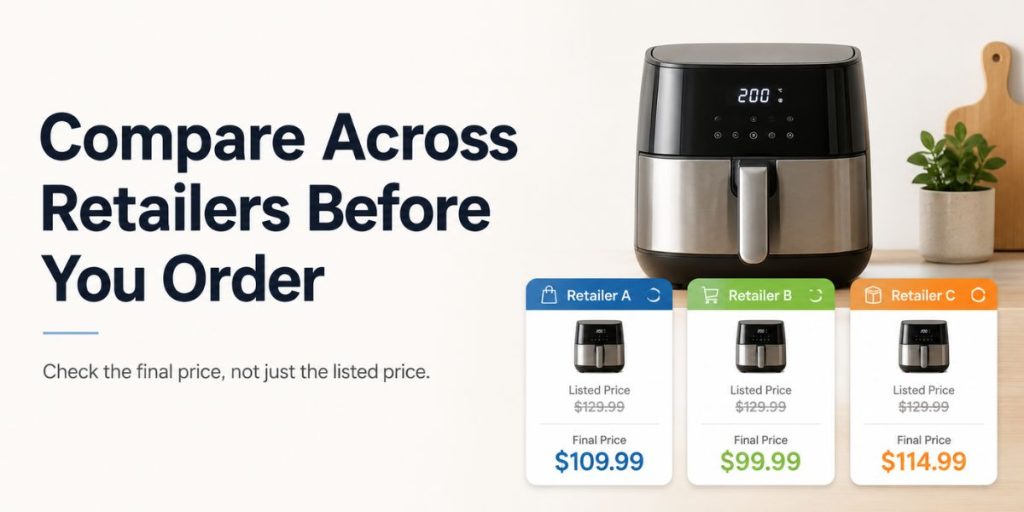
The same appliance can be priced differently across retailers, and discounts can change depending on the sale, bank offer, exchange deal, or platform. Comparing prices before you buy can help you find a better overall deal.
Check at least two or three retailers and compare the final cost, not just the listed price. Include delivery charges, installation fees, exchange value, bank discounts, and any extended warranty or additional services included with the purchase.
Amazon and Flipkart offer a wide range of home appliances and regularly run sale and exchange offers. Croma is another useful option, especially if you prefer to compare products online and also visit a physical store before making a decision.
Once you find the best retailer and price, check whether you can earn additional cashback through CashKaro. The next section explains how this can help you save further.
Stack the Sale Price, Bank Offer and Cashback
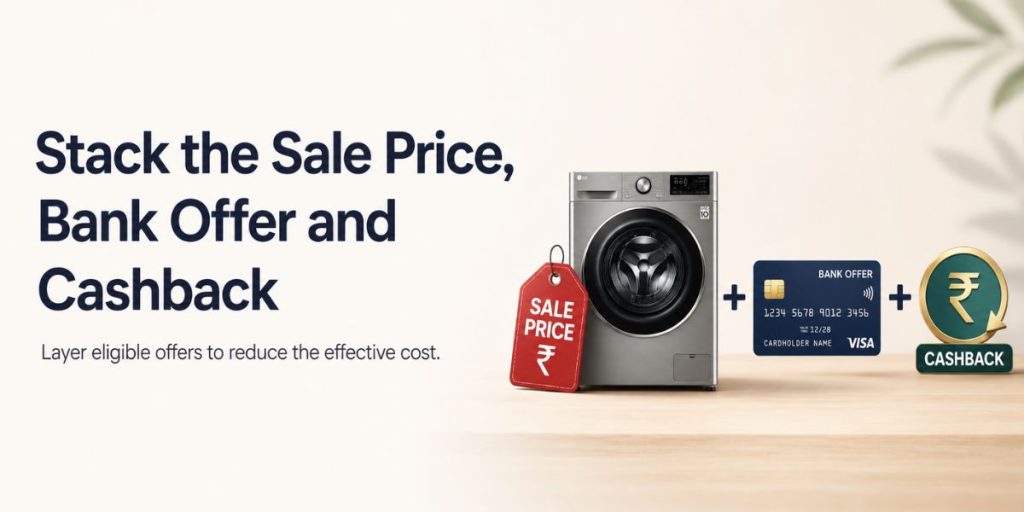
A good appliance deal is not always about finding the lowest listed price. The bigger saving often comes from combining multiple offers that apply to the same purchase.
For example, a ₹40,000 appliance may already be discounted during a festive sale. An eligible bank offer can reduce the checkout price further, and cashback through CashKaro can bring down the effective cost after the purchase is confirmed.
| Step | Amount |
| Listed price | ₹40,000 |
| Festive sale price | ₹32,000 |
| After bank offer | ₹29,000 |
| After CashKaro cashback | ₹28,130 |
In this example, the effective cost falls from ₹40,000 to ₹28,130, giving you a total saving of ₹11,870.
The important thing is to check each offer separately. Bank discounts often come with conditions such as a minimum transaction value, an eligible card, or a maximum discount cap. Cashback also has its own tracking and eligibility rules, so the highest advertised percentage does not always mean the highest actual saving.
Before placing the order, compare the final payable amount across retailers and then check the cashback available on Amazon, Flipkart, or Croma. Visit the retailer through CashKaro before completing the purchase and follow the store-specific cashback terms, including any coupon restrictions.
This approach is especially useful for expensive appliances because even a small additional percentage can translate into a meaningful amount. For example, an extra 3% cashback on a ₹30,000 purchase is worth ₹900.
If you are shopping for a refrigerator, you can also check the refrigerator offers page to compare available deals and cashback before deciding where to buy.
Look After What You Already Own
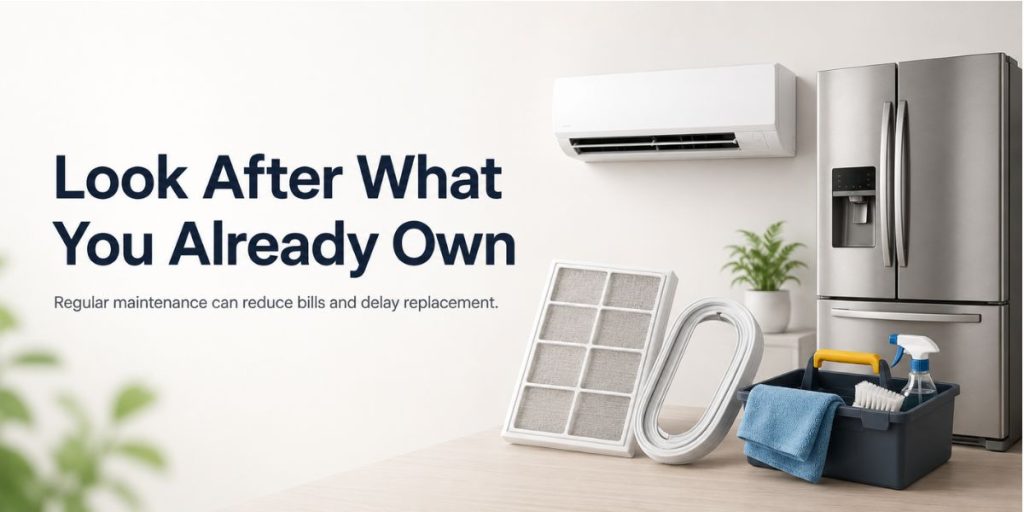
Taking care of the appliances you already own can save you just as much as finding a good deal on a new one. Regular maintenance can improve efficiency, reduce repair costs, and help your appliances last longer.
- Clean the filters regularly. Dust can build up in air conditioner filters and reduce airflow, making the AC work harder to cool the room. Clean the filters regularly during periods of frequent use to help maintain performance and efficiency.
- Check refrigerator door seals. A loose or damaged door gasket can allow cold air to escape, forcing the refrigerator to work harder to maintain the set temperature. Replacing a worn seal is usually much cheaper than dealing with higher electricity consumption or major repairs later.
- Follow the recommended service schedule. Do not wait for an appliance to develop a fault before getting it checked. Follow the manufacturer’s maintenance recommendations to help keep the appliance running efficiently and identify potential problems early.
- Avoid overloading appliances. Overloading a washing machine can put extra strain on the motor and reduce washing performance. Similarly, overcrowding a refrigerator can restrict airflow inside and affect cooling efficiency.
- Allow enough space for ventilation. Appliances such as refrigerators need adequate space around them to release heat properly. Follow the manufacturer’s installation guidelines and avoid placing the appliance too close to a wall if ventilation space is required.
Good maintenance may seem like a small step, but over the life of an appliance, it can help reduce electricity costs, avoid unnecessary repairs, and delay the need for a replacement.
Conclusion
Saving money on home appliances is about making the right choice before you buy. Compare energy efficiency, size, service support, prices, and available offers to find the best overall value. Planning your purchase carefully can help you save both upfront and over the long term.
Frequently Asked Questions
How can I save money on home appliances in India?
Compare BEE ratings, choose the right size, check service support, shop during sales, and combine eligible discounts and cashback.
What is the BEE star rating and does it really save money?
The BEE star rating shows an appliance’s energy efficiency, with higher-rated models generally consuming less electricity.
Is a 5-star appliance worth the extra cost?
It can be worth it for frequently used appliances if the long-term electricity savings recover the higher upfront price.
What is the BEE label period and why does it matter?
The label period shows which BEE efficiency standards apply, so always check that you are comparing appliances under the relevant rating period.
Do washing machines have BEE star ratings?
Some washing machines carry BEE star ratings, so check the label and annual energy consumption when comparing models.
Which brand is best for home appliances in India?
The best brand depends on the appliance category, your budget, features, reliability, and after-sales service available in your city.
When is the best time to buy home appliances in India?
Major festive and seasonal sales are usually good times to look for discounts, bank offers, and exchange deals.
What size refrigerator or AC do I need?
Choose the capacity based on your household size, room size, usage, climate, and the manufacturer’s recommendations.