How to Save Money on Beauty Products in India 2026

Quick Summary
Searching for ways to save on beauty products in India? Focus on four things: where you buy, when you buy, what size you choose, and how many discounts you can stack at checkout. Buying from a brand’s own website during a sale, then combining an eligible coupon, bank offer, and cashback through platforms like CashKaro, can help you bring down the final cost significantly compared with paying the listed marketplace price.
Most advice on ‘How to save on beauty products’ tells you to buy fewer products. That’s not a savings strategy; it’s a lifestyle instruction, and it doesn’t help someone who has already decided they want the vitamin C serum. This guide assumes you’re going to buy the thing. It’s about not overpaying for it.
India’s beauty and personal care market is around $20 billion and growing at 10–11% a year, making it the fastest-growing BPC market in the world (source). Rapid growth means aggressive competition between platforms, and competing platforms price the identical SKU differently. That gap is your money.
The goal, then, isn’t to spend less by skipping what you want, but to pay the lowest possible price for the exact product you were already planning to buy.
Top Beauty Products Saving Tips in India
Compare Cost Per Use, Not Pack Price
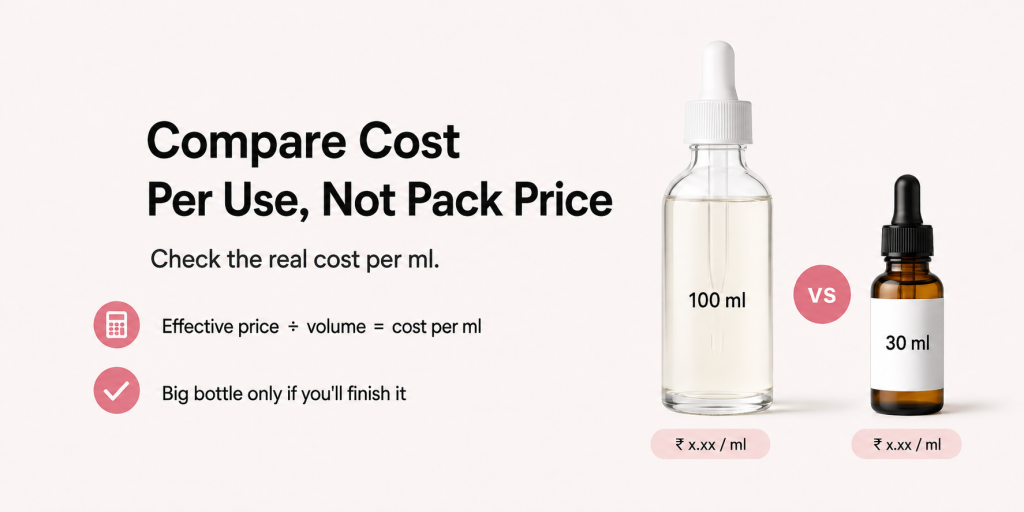
Stop comparing prices, start comparing effective price per usage. This is the single habit that saves the most, and almost nobody does it.
The sticker price on a product page is not what you pay, and the size on the label is not what you use. Effective price per ml collapses both into one number you can actually compare across platforms.
How to calculate it: Effective price ÷ volume in ml = your real cost per ml
Where effective price = MRP − platform discount − coupon − bank offer − cashback
A worked example:
| Step | Amount |
| Listed price, 100 ml serum | ₹899 |
| Platform sale discount, 20% | −₹180 |
| Coupon code applied at checkout | −₹100 |
| Bank card offer, 10% capped at ₹75 | −₹62 |
| Cashback tracked on the order | −₹83 |
| Effective price | ₹474 |
| Cost per ml | ₹4.74 |
The same serum in a 30 ml “trial” size at ₹349 works out to ₹11.63 per ml; 145% more expensive per ml, even though it looks cheaper on the shelf. This is the most common way Indian shoppers lose money on beauty: mistaking a low sticker price for a low price.
The exception that matters: per-ml logic only holds if you finish the product. A 100 ml serum you use for six weeks and abandon costs infinity per ml. Buy the large size only for things you have already repurchased at least once.
Buy Only What You Can Finish Before It Expires
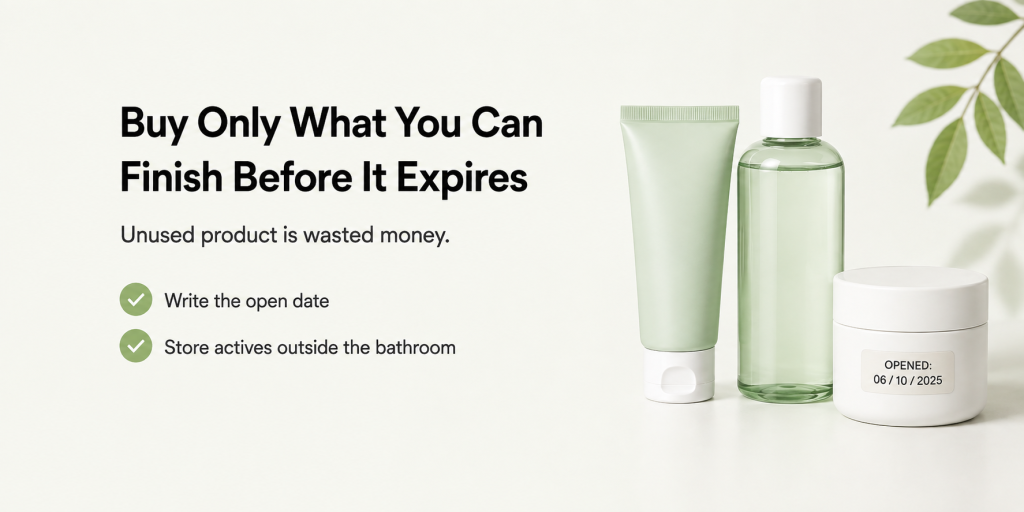
The cheapest rupee in your beauty budget is the one you never spend replacing something that went off unused. A ₹1,400 serum you finish is cheaper than a ₹700 serum you throw away half full.
Three habits that make it easy to use a product before it gets expired:
- Write the open date on the bottle in marker. Two seconds, ends all guessing.
- Run one-in-one-out per category. No new cleanser until the current one is done. Most overspending in Indian beauty isn’t about price, it’s about duplication.
- Store actives outside the bathroom. Indian bathroom heat and humidity degrade vitamin C, retinol and niacinamide faster than one assumes. A bedroom drawer buys you real weeks.
Twice a year, empty every drawer and note what you bought and never finished. That list is your actual savings plan for next year.
Know Which Products Actually Justify the Value Size
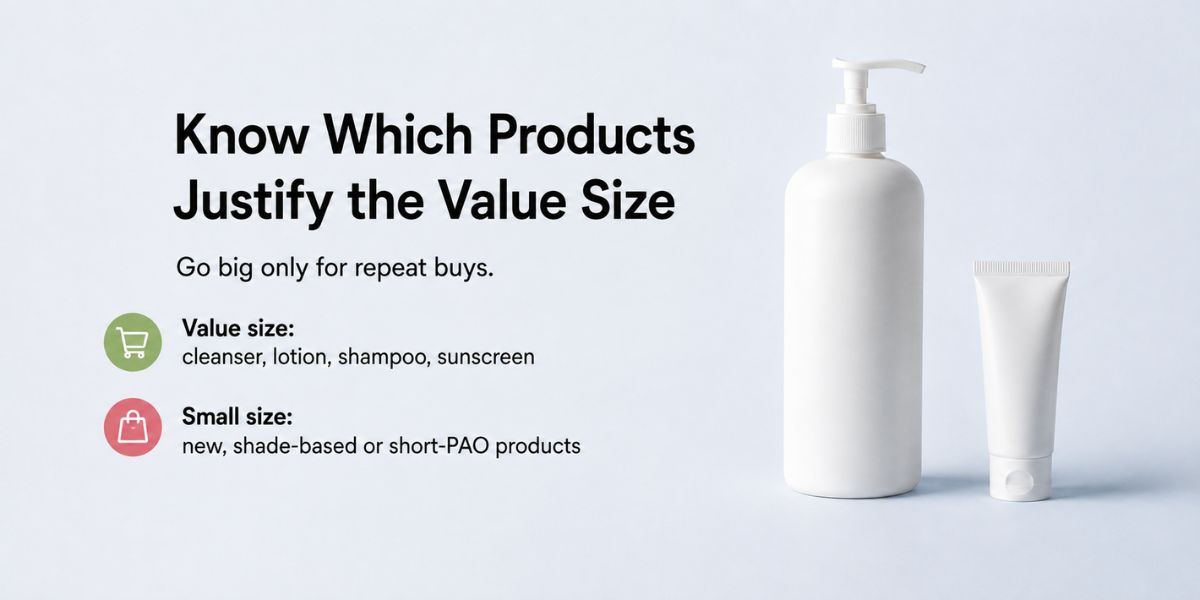
Bigger is cheaper per ml, and that only matters if you reach the bottom of the bottle. The decision is different for every product type.
Buy the value size for: cleansers, body lotion, shampoo, micellar water, sunscreen you use daily, and any product you have already repurchased at least once. These are high-turnover, stable, and you know you’ll finish them.
Buy the small size for: anything you’ve never used, anything with a 3–6 month PAO (Period After Opening), and any shade-dependent product you can’t test first.
On mini and travel sizes: worth buying for exactly one purpose. Choose when testing something new and the alternative comes at a high cost and you might abandon after two uses. Never for restocking.
On combo and bundle packs: genuinely cheaper on brand websites, where D2C brands build routines you can’t assemble at that price on a marketplace. But do the arithmetic: a four-product routine bundle is only a saving if you’d have bought all four separately. Bundles that include one product you don’t want are usually a loss disguised as a discount.
On refill pouches: several Indian brands sell refills at a discount to the bottled version. Same formula, less packaging, lower price. Availability varies by SKU, so check the brand’s site rather than assuming, but where it exists it’s a clean saving
Check the New-user Rate Before You Check Out
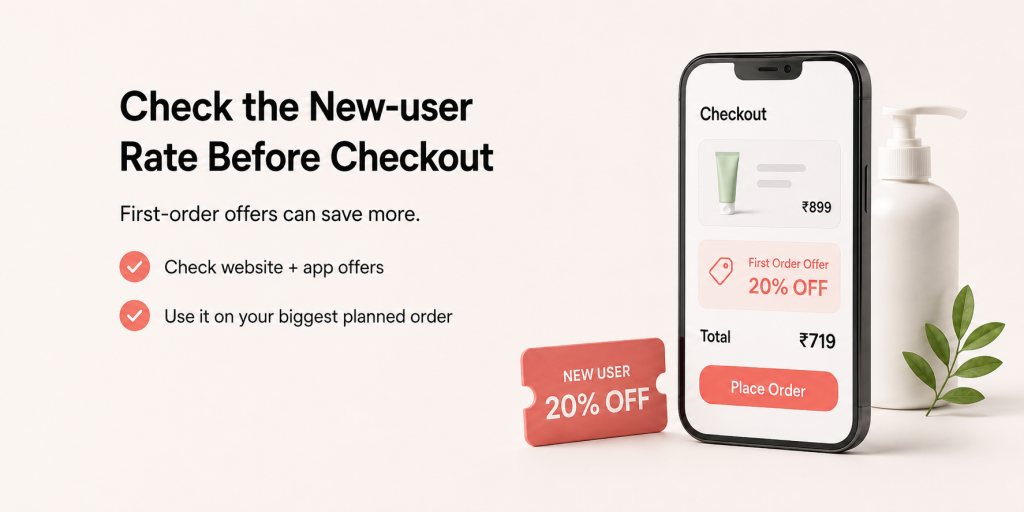
First-order offers in Indian beauty are unusually generous, and they exist on three separate layers that most people only claim one of.
Layer one: the retailer’s first-order code. Nearly every Indian beauty platform runs one. D2C brand sites typically run 10–20% off a first order, often with a lower minimum than the marketplaces.
Layer two: app-only first-order offers. Several platforms reserve their best new-user code for the app rather than the mobile site. If a code fails on desktop, try it in the app before assuming it’s expired.
Layer three: new-user cashback bonuses. Cashback platforms often run a signup bonus or an elevated first-transaction rate that sits above the standard store rate. Worth checking before your first order, not after.
The rules that make these work:
- New-user codes are one-time and tied to your registered email or phone number. Creating secondary accounts to re-claim them breaches most platforms’ terms and can get the account suspended, which costs you far more than the ₹100 you saved.
- Spend your new-user code on the largest order you’ll place, not the first small one. A 20% first-order discount on a ₹400 cart is ₹80; on a ₹2,500 cart it’s ₹500. Once it’s used, it’s gone.
- If you’re buying across four brands, place the first order on the brand where the new-user discount is worth most, and buy the rest without it.
Stack a Coupon with Cashback Correctly
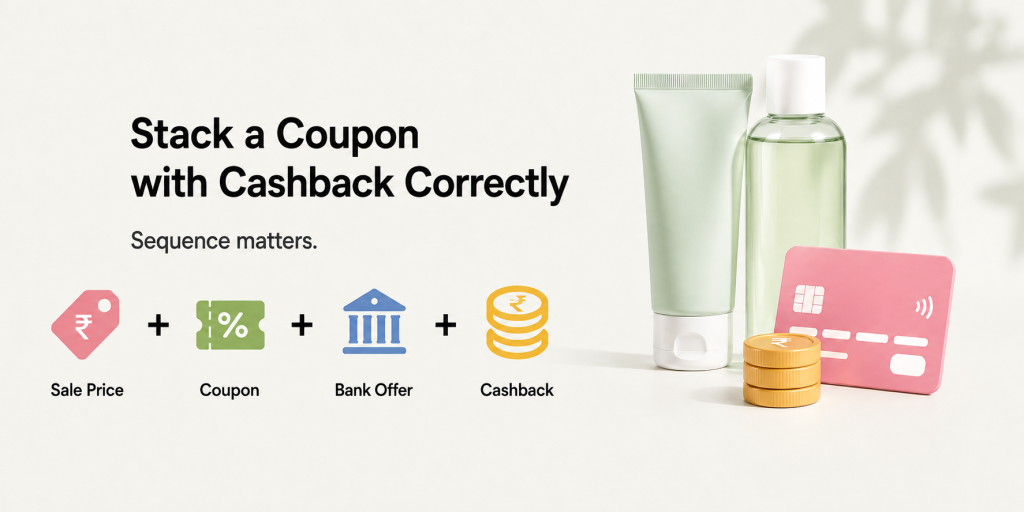
Coupons and cashback are not alternatives. They apply at different points and both work on the same order, but only if you sequence them right.
The correct order at checkout:
- Platform discount: automatic, already in the listed price
- Coupon code: applied in the promo field at checkout
- Bank or payment offer: applied at the payment page (covered separately in point 7)
- Cashback: tracked from the moment you begin, credited after the retailer confirms
Note: Only one coupon code per order on almost every Indian platform. If you have two or three, test each and keep whichever cuts the cart most. Do the maths, don’t default to the bigger-sounding percentage.
Cashback is the only layer that works on top of everything else rather than competing with it. It doesn’t reduce what you pay today; it returns money to your account after the order is confirmed. That makes it worth the extra click on all orders.
Things that silently kill cashback tracking:
- Opening another coupon site in a new tab after clicking through. The last click wins, and you’ll lose the tracking to whoever you visited most recently.
- Ad blockers, which interrupt the tracking redirect entirely.
- Cancelling and re-placing the order after checkout.
Also check whether app orders are eligible. Some stores track app purchases and some don’t, and it’s stated on the store page worth thirty seconds before you switch from browser to app mid-purchase.
Shop Where the Cashback Actually Is
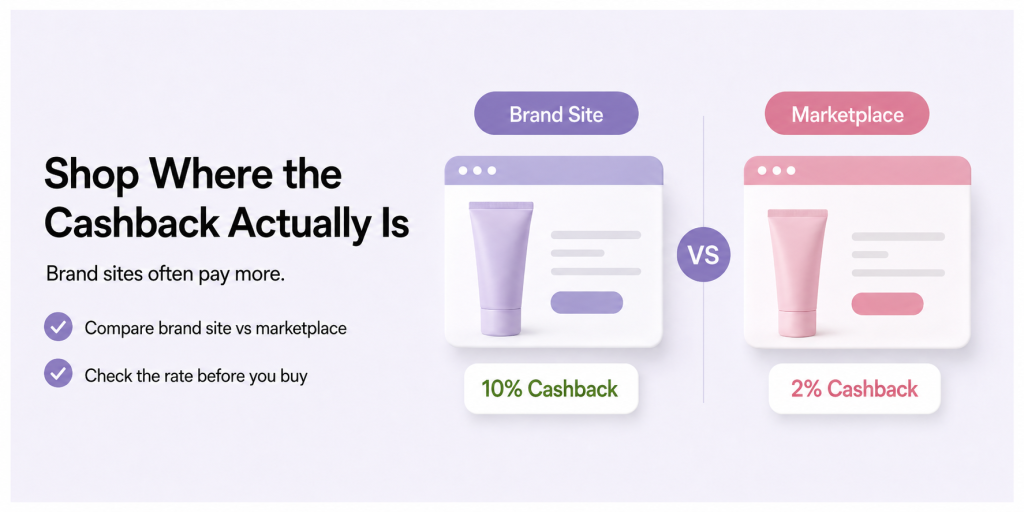
Cashback rates in Indian beauty vary by a factor of three or more between channels, and the pattern is stable enough to plan around: brand-owned websites pay far more than marketplaces.
D2C brands earn much better margin selling to you directly than through a marketplace, and they share a slice of that back.
CashKaro rates on beauty brand sites include:
| Brand / Store | CashKaro Cashback Rate |
| Ounce Organics | Flat 80% Cashback on all Orders |
| The Derma Co | Flat 18% Cashback on all Orders |
| Swiss Beauty | Flat 18% Cashback on all Orders |
| WOW Skin Science | Flat 16% Cashback on all Orders |
| Foxtale | Flat 15% Cashback on all Orders |
| mCaffeine | Flat 15% Cashback on all Orders |
| Aqualogica | rate needed |
| Dot & Key | Up to 12% Cashback on all Orders |
| Hyphen | Flat 12% Cashback on all Orders |
| Forest Essentials | Flat 12% Cashback on all Orders |
| Myntra | Up to 6% Cashback on Beauty Products |
| Amazon | Flat 5% Cashback on Beauty Products |
| Flipkart | Up to 3.25% Cashback on Beauty Products |
Rates as of August 2026 and subject to change. Check the store page for the current rate and offer terms before ordering.
What this means practically:
- Restocking one brand you already use? Start at that brand’s own website. Usually better priced once first-order codes and bundles are counted, and typically three times the cashback.
- Buying across four brands at once? A marketplace is worth the lower rate for one delivery and one checkout.
- Buying imported or prestige beauty? Go to the authorised specialist channel regardless of rate. Authenticity beats cashback every time.
How to Earn Cashback on Beauty Products:
- Open the CashKaro website or app and search for the brand or store you want to shop from.
- Check the current cashback rate and offer terms on the store page, including whether app orders are eligible.
- Click the orange button to visit the retailer’s official site. Do not add items to your cart before this step.
- Shop as usual and apply an eligible coupon at checkout — only codes listed on CashKaro or the retailer’s own website.
- Complete the payment in the same session, without visiting another coupon or cashback site in between.
- Your cashback appears as pending in your CashKaro account once the order tracks, and is confirmed after the retailer’s return window closes.
Time Big Restocks to Real Sale Windows
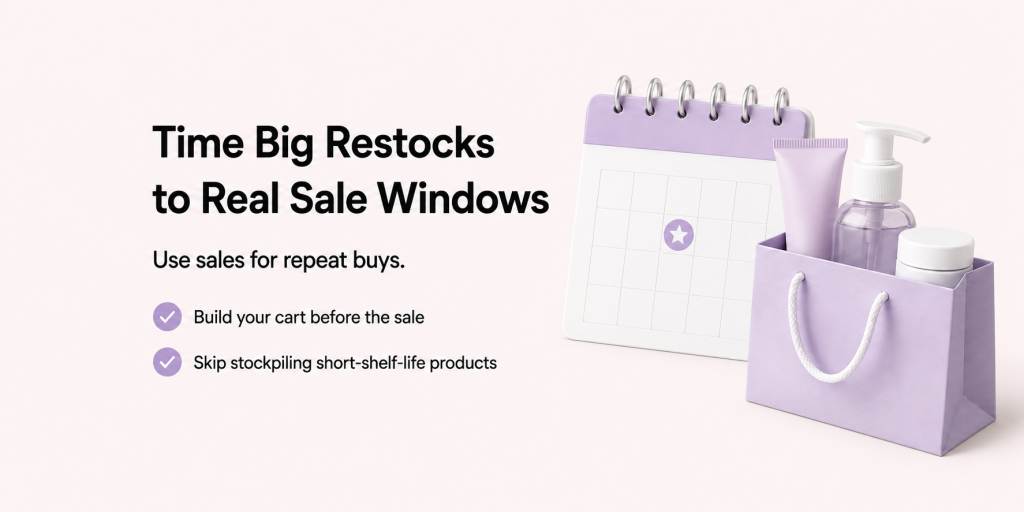
Beauty discounting in India is seasonal and repeats every year. Multiple sales run throughout the year where luxury beauty and high-end makeup are available at steepest discounts.
Three rules for shopping a sale properly:
- Build the cart before the sale, not during it. Wishlist items weeks ahead so you can see the pre-sale price. That’s the only way to tell whether a “60% off” is real or an inflated MRP.
- Buy consumables in sales, buy experiments never. A sale is for your third bottle of a cleanser you know works. A shade you’ve never tried isn’t a bargain at any discount.
- Skip sales entirely for short-shelf-life products. Stocking up on six months of vitamin C at 50% off is a 100% loss if three bottles oxidise before you get to them.
Note: Dates shift year to year and are usually announced only days in advance. Keep a check on official websites to know when the next sale is scheduled.
Check Bank and Payment Offers Separately
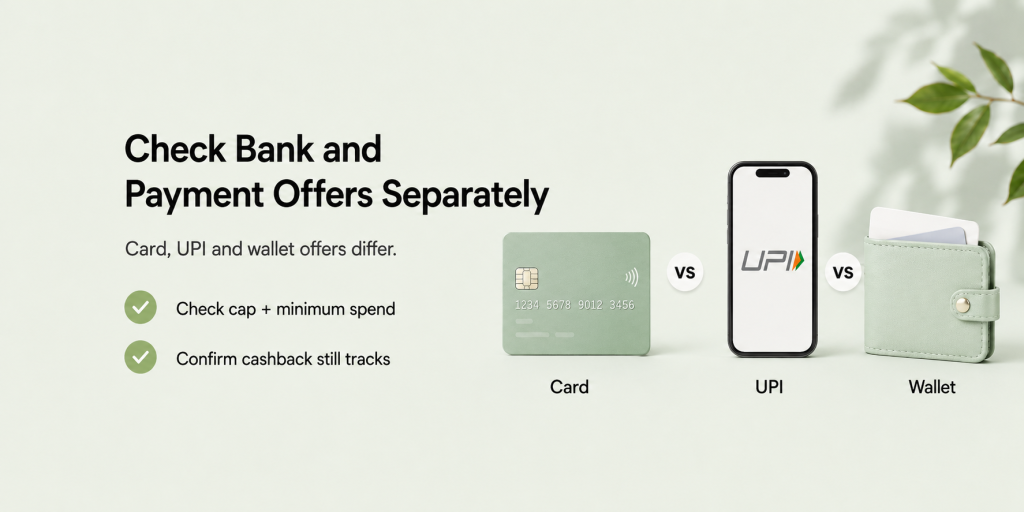
Bank offers and payment-method offers are two different things; they’re claimed at two different moments, and most shoppers only ever notice one.
Bank card offers apply at the payment page, after your coupon. They’re percentage-based with a rupee ceiling and a minimum order value, typically structured around particular bank or card usage.
Payment-method offers are separate and easy to miss. UPI-specific discounts, wallet offers and app-payment cashback all sit in this bucket and often stack independently of the card offer.
How to actually claim these:
- Check the offer strip before you build the cart, not at payment
- Compare the cap against your cart
- Check the per-card usage limit
- Confirm cashback still tracks on your chosen payment method
Avoid the Returns-and-exchange Trap
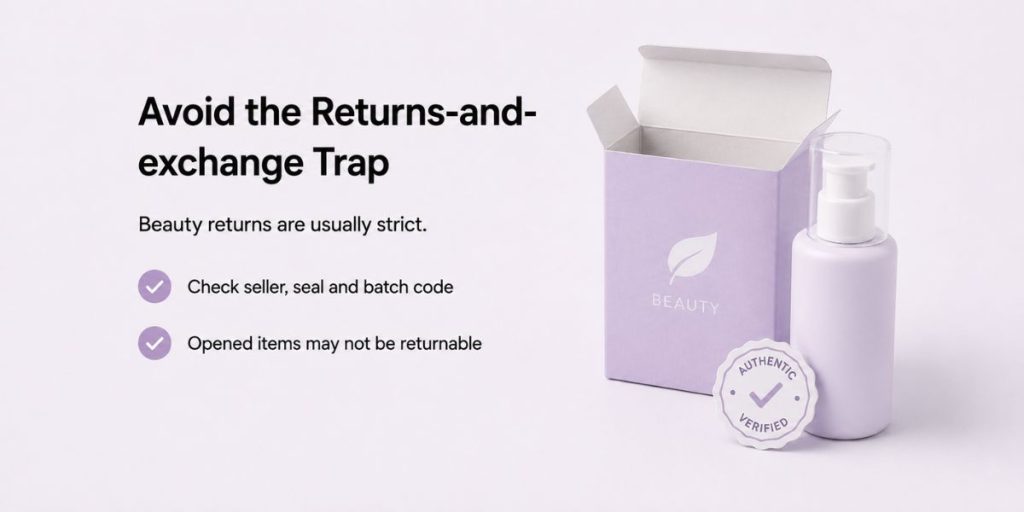
Beauty has the most restrictive return policies in Indian e-commerce, and nobody reads them until something goes wrong. A product you can’t return isn’t discounted; it’s a total loss.
The exclusions that catch people out:
- Allergic reactions are usually not covered. Most brand policies state plainly that products returned because of allergic reactions are not accepted, and sensitivity or allergy issues must be taken up with the manufacturer or brand. This is standard across the category, not unusual.
- D2C brand sites are stricter than marketplaces. Brands provide refunds or replacements only for a wrong shipment, a defective product, or an expired item, with the request raised within seven days of delivery and no claims accepted after that. The higher cashback on brand sites comes with a narrower return window; that’s the trade-off, and it’s a fair one as long as you know it going in.
- Opened products generally can’t be returned unless they were defective or wrong on arrival.
- Returning an order usually voids the cashback on it, since the retailer never confirms the sale.
Check before any marketplace purchase:
- Check the seller name. Prefer the brand’s official storefront or a named authorised distributor over a generic third party.
- Distrust extreme discounts. 70% off a prestige product outside a known sale window is the strongest single signal something is wrong.
- Read reviews for packaging complaints, not product complaints. “Seal was broken”, “batch code missing”, “texture felt different” are the tells.
- Check the batch code and manufacturing date on arrival. Missing or smudged codes are a red flag.
- Buy imported and prestige beauty from specialist retailers. Counterfeit risk is materially lower on authorised beauty platforms than on open marketplaces, which is why authenticity positioning is a genuine point of difference against general marketplaces.
Monthly Routine for Saving on Beauty Products
- Once a month: list what runs out in the next 30 days. Buy it in one planned order, not five panic orders.
- Before every order: check the brand’s own site against the marketplace price for the same SKU.
- At checkout: coupon first, payment offer second, cashback tracked from the start.
- Before confirming: check the return window on anything shade-dependent.
- On arrival: date the bottle.
- Twice a year: clear out what’s past PAO and note what you never finished.
Conclusion
Saving on beauty products is less about hunting discounts and more about not wasting product. Compare what a day of use costs rather than what the bottle costs, buy sizes you can finish inside the period after opening, and reserve stockpiling for high-consumption basics rather than actives and mascara.
When you do buy, the order in which you apply savings matters: genuine sale price first, then an eligible coupon, then cashback, then a compatible bank offer. Check the live rate and terms before every order, because both move.
Disclaimer: This article is for general information. Product suitability varies by skin type and condition. Consult a qualified dermatologist for concerns such as persistent acne, pigmentation or reactions to actives.
FAQs
How can I save money on beauty products in India?
Compare cost per use instead of pack price, buy only what you can finish before the product expires, restock during genuine sale events, and combine an eligible coupon with cashback and a compatible bank offer. Checking whether you qualify for a new-user cashback rate before ordering also makes a measurable difference.
Is it cheaper to buy from Nykaa or from the brand’s own website?
It depends on the total after discounts. Brand websites currently pay significantly higher cashback than the large beauty marketplaces. If a marketplace discount is deeper than that gap, the marketplace still works out cheaper. Compare the final amount.
Do beauty products expire?
Yes. Cosmetics sold in India must carry a use-before or expiry date under the Cosmetics Rules, 2020. Many products also print an open-jar symbol with a number and “M”, which is the period after opening.
Can I use a coupon and cashback together on beauty products?
Usually yes, if the coupon is listed on CashKaro or on the retailer’s own website. Using a code from a third-party site, or visiting another coupon site after clicking through, can prevent the order from tracking. Complete the purchase in one session.
Is a bigger pack always cheaper?
No. A larger pack lowers cost per use only if you finish it within its period after opening. Value sizes usually make sense for sunscreen, cleanser, shampoo and body lotion.
When is the best time to buy beauty products in India?
Major platform events give the deepest cuts: Nykaa’s Pink Friday and Hot Pink sales, Myntra’s End of Reason Sale and Big Fashion Festival, and the Amazon and Flipkart festive sales. Brand websites also run their own anniversary and festive events.
Does returning or exchanging an order affect cashback?
Yes, most of the brands cancels cashback on orders that are exchanged or replaced, and most retailers do not pay cashback on returned items.