How to Buy Perfume for Less in India: Price Per mL, Dupes & Sale Timing (2026)

Quick Answer:
Wondering how to buy perfume for less in India? Stop comparing sticker prices and start comparing ₹ per mL. Buy EDP rather than EDT; choose Indian houses over imported designer bottles, buy the 100ml instead of the 30ml, and time the purchase for the festive stretch between September and Diwali. Then stack the three discount layers that work independently of each other: the sale price, a bank card offer, and cashback by CashKaro.
Done properly, that gets you a 100ml EDP at roughly ₹3–₹5 per ml, which will be about ₹285 per ml.
Perfume is one of the few categories in India where the printed price tells you almost nothing about what you should pay. Two forces inflate the number on the shelf, and neither one is the liquid inside the bottle.
The first is import duty and distributor margin. The second, and more relevant to most buyers, is MRP anchoring. Indian fragrance MRPs are deliberately set high so the discount looks dramatic.
So, the first habit to build is this: never treat MRP as a reference point. Check a price-history tool before any perfume purchase above ₹1,500, and if the current price sits above the historical average, wait.
Everything below is the rest of the method.
Best Ways to Buy Perfume for Less in India
Do the Price-Per-mL Maths
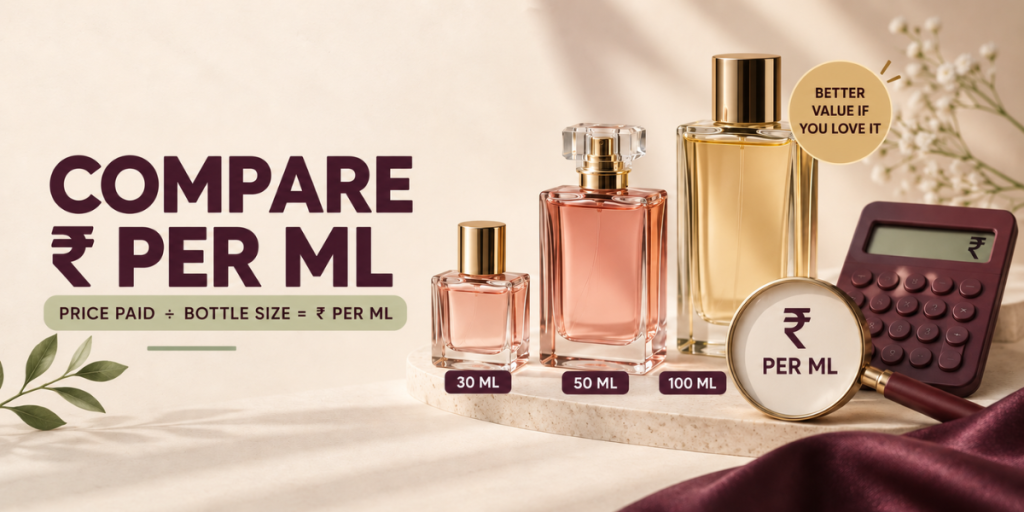
One calculation, every time: ₹ per ml = price paid ÷ volume in ml
Here’s what that reveals across the Indian market, using current real prices:
| Fragrance | Size | Street price (approx.) | ₹ per ml |
| Bella Vita CEO Man EDP | 100ml | ₹485 | ₹4.9 |
| Bella Vita 3-perfume bundle | 3×100ml | ₹1,298 | ₹4.3 |
| Ajmal Ascend | 100ml | ₹599 | ₹6.0 |
| Armaf Tres Nuit EDP | 100ml | ₹2,052 | ₹20.5 |
| Armaf Hunter Intense EDP | 100ml | ₹2,296 | ₹23.0 |
| Lattafa Khamrah EDP | 100ml | ₹2,974 | ₹29.7 |
| Armaf Club de Nuit Intense Man EDT | 105ml | ₹4,364 | ₹41.6 |
| Creed Aventus EDP | 100ml | ₹28,500 | ₹285 |
Note: These prices are subject to change. Check before you buy.
The size trap: brands push 15ml, 20ml and 30ml bottles because a smaller number sells more easily. Bella Vita’s 3×15ml and 3×20ml gift collections cost far more per ml than 100ml singles from the same brand. If you like a scent, buy the big bottle; it’s nearly always the cheaper decision per spray.
Buy the Right Concentration
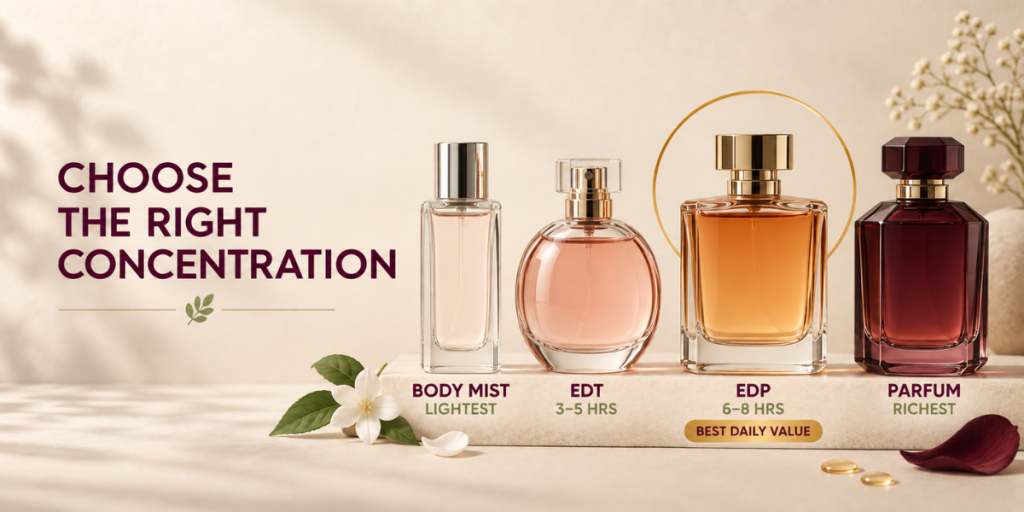
Price tracks aromatic oil percentage, and knowing the ladder stops you from paying for dilution.
| Type | Oil concentration | Typical longevity | Verdict for India |
| Body mist/body spray | 1–3% | 1–2 hours | Gym bag only |
| Eau de Cologne | 2–4% | 2 hours | Skip |
| Eau de Toilette (EDT) | 5–15% | 3–5 hours | Fine for peak summer |
| Eau de Parfum (EDP) | 15–20% | 6–8 hours | Default buy |
| Parfum / Extrait | 20–30% | 8–12+ hours | Occasions; 1–2 sprays |
Here’s the part most buyers miss: price and concentration don’t reliably correlate. A brand’s best-known, most heavily marketed release is often an EDT, priced above the same brand’s quieter EDPs.
Two fragrances from the same house, on the same shelf, can invert the value equation entirely. The only way to know is to read the concentration on the label, which is printed on every box, and then divide by volume. The consequence shows up in how fast the bottle empties.
Cost per wear is the number that matters, and a cheaper EDT frequently loses to a pricier EDP on exactly that measure.
Stack the Three Savings Layers
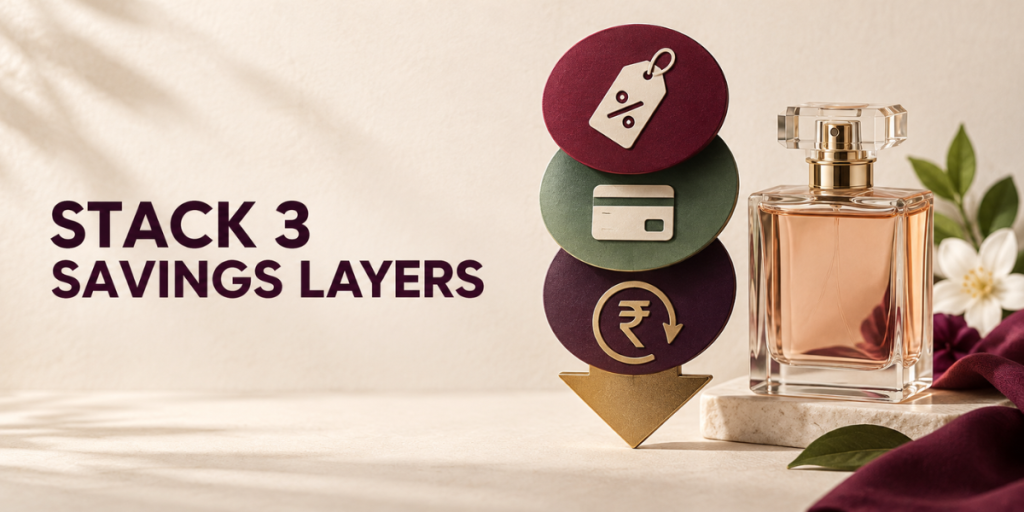
This is where most of the money is, and where most buyers leave it on the table.
Every online fragrance purchase in India carries three independent discount layers. Independent is the operative word; they compound rather than replace each other:
- The retailer’s discount: the markdown itself.
- The payment offer: a bank card instant discount or a coupon applied at checkout.
- The cashback layer: a rebate on order value, credited separately after the fact.
A worked example. A three-bottle bundle from an Indian D2C fragrance brand, bought on the brand’s own site:
| Layer | Effect | Running total |
| Brand bundle: 3×100ml EDP | — | ₹1,298 for three |
| Prepaid order discount (5%) | −₹65 | ₹1,233 |
| Cashback via CashKaro (18%) | −₹222 | ₹1,011 |
Three 100ml EDPs for ₹1,011 works out to ₹3.4 per ml, under a fiftieth of what an imported niche fragrance costs per spray, for something you’ll wear daily without thinking about it.
Let the cashback rate decide where you buy, not just what. Rates vary enormously by retailer type, and the spread is wide enough to change the decision.
CashKaro is one of the best cashback platforms that hosts 1500+ brands and offers cashback over and above ongoing brand discounts. You will also find CashKaro’s exclusive coupon codes for some brands for extra savings.
| Where you’re buying | Coupon Code | Code Offering | Cashback Rate |
| Ajmal Perfumes | CKXAP10 | Flat 10% | Flat 3% |
| Fraganote | CK15 | Flat 15% | Flat 40% |
| Bella Vita Organic | – | – | Flat 18% |
| TM Perfumes | – | – | Flat 8% |
| Titan Skinn | – | – | Flat 12% |
| The Man Company | – | – | Flat 15% |
| Aqualogica | – | – | – |
| mCaffeine | – | – | Flat 18% |
Note: Rates change frequently and without prior notice. So, check the store page before you buy.
The honest version of how the cashback layer works. It’s one extra click, but it isn’t magic, and it isn’t instant:
- You reach the retailer through CashKaro and complete the purchase in that same session.
- Tracking speed varies by merchant; some register within minutes; others take up to 36 hours.
- It then sits as pending until the merchant confirms, which only happens once the return window closes.
- Cashback is calculated on order value excluding shipping and platform fees.
- A coupon code sourced elsewhere can void it. Stick to codes listed on the cashback site or the merchant’s own site.
- If it doesn’t track, there’s a 30-day window to raise a missing-cashback ticket.
Understand the Dupe Market
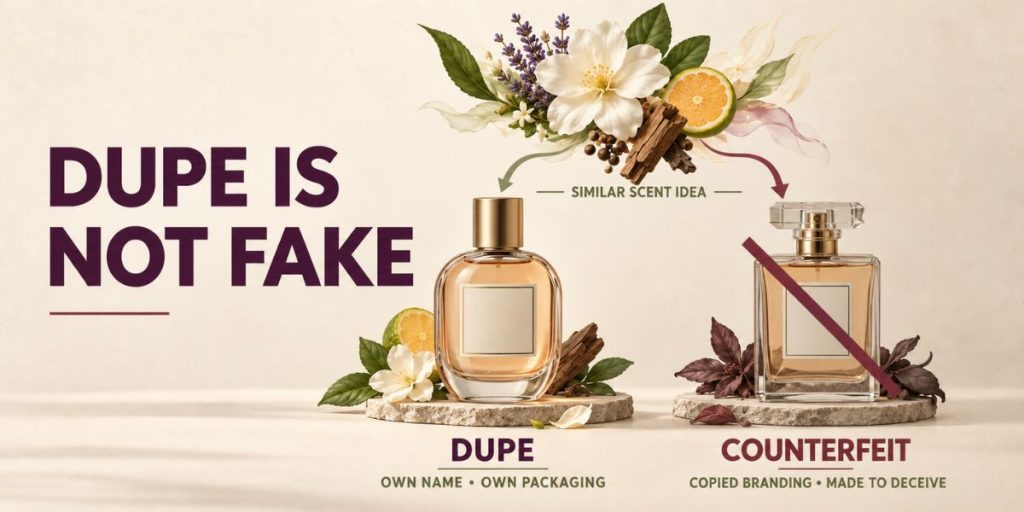
A dupe is not a fake. Fragrance formulas can’t be copyrighted, so any perfume house is free to build a scent profile inspired by a famous original and sell it openly under its own name. That’s entirely legal, and it’s a different thing altogether from a counterfeit passing itself off as the original. In India, this has stopped being a niche and become the default value play; several houses now run catalogues of a few hundred recreated alternatives, often at higher stated oil concentrations than the designer bottles they’re modelled on.
Treat scent-match percentages as marketing. Sellers in this category routinely advertise a “90%” or “95% match” to the original. There’s no standard test for scent similarity, so every one of those figures is the seller’s own assessment of its own product. What you can verify is the price gap and the concentration on the label. The resemblance itself is subjective, and it’s the one claim you have to test on your own skin.
The honest pattern across dupes:
- First 20 minutes: often genuinely close to the original. The opening notes are the cheapest part of a fragrance to replicate.
- Dry-down: drifts. This is where cheaper aroma materials show. This is where less expensive aroma materials show themselves.
- Longevity: typically 30–50% shorter than the original.
Note:
– Dupes are the right call for: daily office wear, college, commuting, budget gifting, and building a wardrobe of five or six scents instead of owning one expensive bottle.
– Originals still win for: a long event where the scent has to hold twelve hours, and any situation where the dry-down matters as much as the opening.
Sample Before You Buy a Bottle
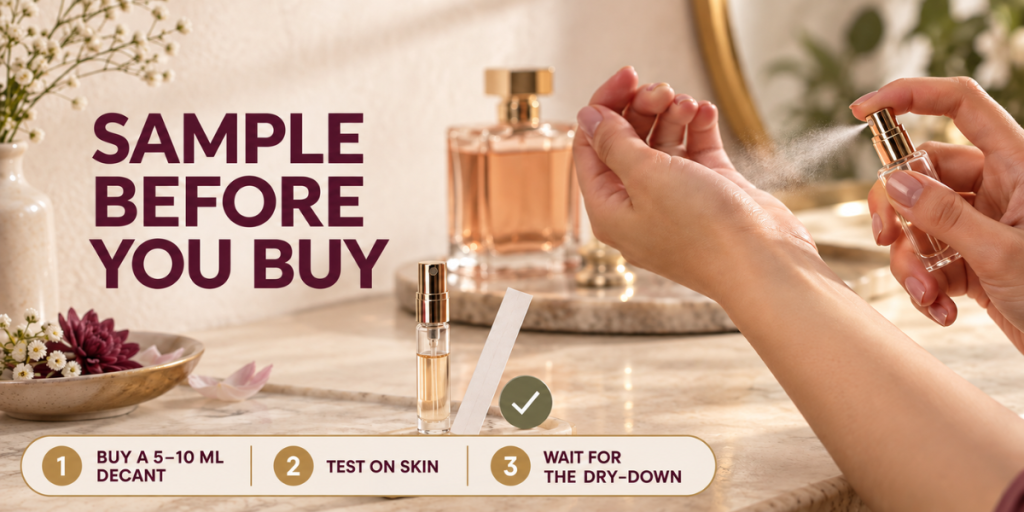
The most expensive perfume you’ll ever buy is a full bottle you don’t like. Most people own one that is bought on a two-second sniff at a store counter, or on a friend’s recommendation, worn twice, then left to sit on a shelf for years.
Decants solve this. A decant is genuine fragrance transferred from the original bottle into a small atomiser, usually 5ml to 10ml, and typically costs ₹300–₹800 depending on what’s inside. Marketplaces now carry them openly alongside the full bottles, and specialist sellers stock the expensive imports that are hardest to test any other way.
Two cautions. Decanting is a largely unregulated, community-driven market in India, so seller reputation is the entire safeguard; look for batch-code photographs, sealed atomisers and a stated return policy. And a decant of a dupe is rarely worth it; decants earn their keep on the ₹8,000+ bottles you’re unsure about.
Testers are the other route: identical juice, plain packaging, no presentation box, commonly 20–40% cheaper. Legitimate testers are genuine stock; buy only from sellers who show batch codes.
How to actually test a sample:
One spray on skin rather than a paper card, and then wait. Paper only shows you the opening. Skin shows you what the fragrance becomes, which is what you’ll be wearing for six hours. Wear it once in the heat before committing, since a composition that reads well in air conditioning can turn cloying outdoors in an Indian summer.
Time the Purchase to the Sale Calendar
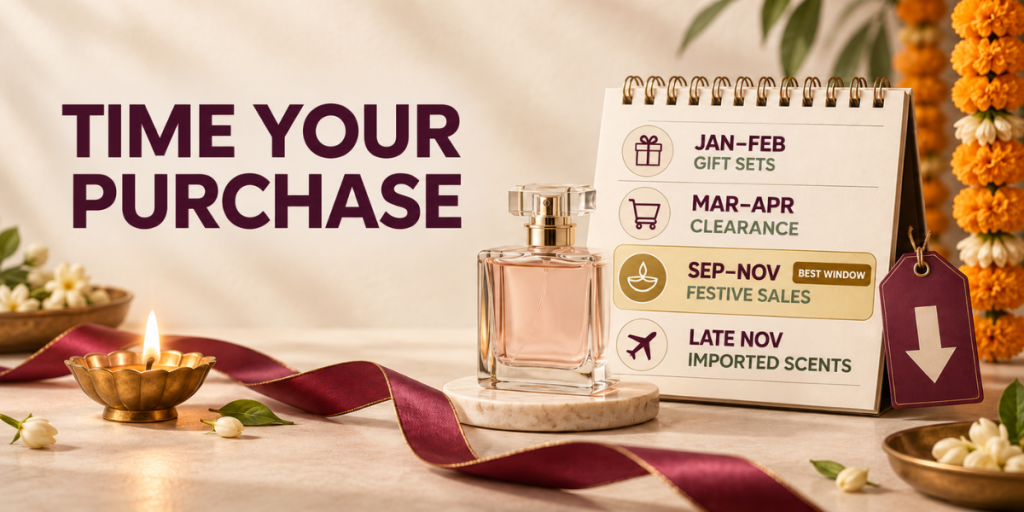
Fragrance discounting in India is seasonal and largely predictable, which means buying off-cycle is the most common way people overpay without realising it.
| Window | What moves | Typical depth |
| Jan–Feb (Valentine’s) | Gift sets, couple packs | 20–40% |
| Mar–Apr (financial year-end) | Retailer clearance, slow-moving stock | 30–50% |
| Jul–Aug (mid-year sales) | Broad beauty catalogues | 25–40% |
| Sep–Nov (festive → Diwali) | Everything; deepest cuts of the year | 35–60% |
| Late Nov (Black Friday) | Imported and niche | 30–50% |
| Dec (year-end) | Leftover festive stock | 20–35% |
The calendar works differently for the two halves of the market.
For imported and designer fragrance, waiting genuinely pays. These bottles hold near-MRP pricing for most of the year and only move properly during flagship sale events, so the festive stretch and Black Friday are when the floor prices appear. If you want a specific imported bottle and it’s April, the honest advice is to wait for September.
For Indian D2C fragrance brands, the calendar barely applies, because these brands run promotions almost continuously. There is essentially never a bad week to buy.
Two traps inside the sale windows. Gift sets cut both ways: a full-size bottle bundled with a deodorant or body wash is often cheaper per ml than the bottle alone, while three 15ml miniatures at a similar price are one of the worst per-ml deals on the shelf, and both get marketed identically. Second, a sale price is only a discount if it’s below the historical average, so run the price-history check hardest in the weeks when the banners are loudest.
Don’t Buy a Counterfeit
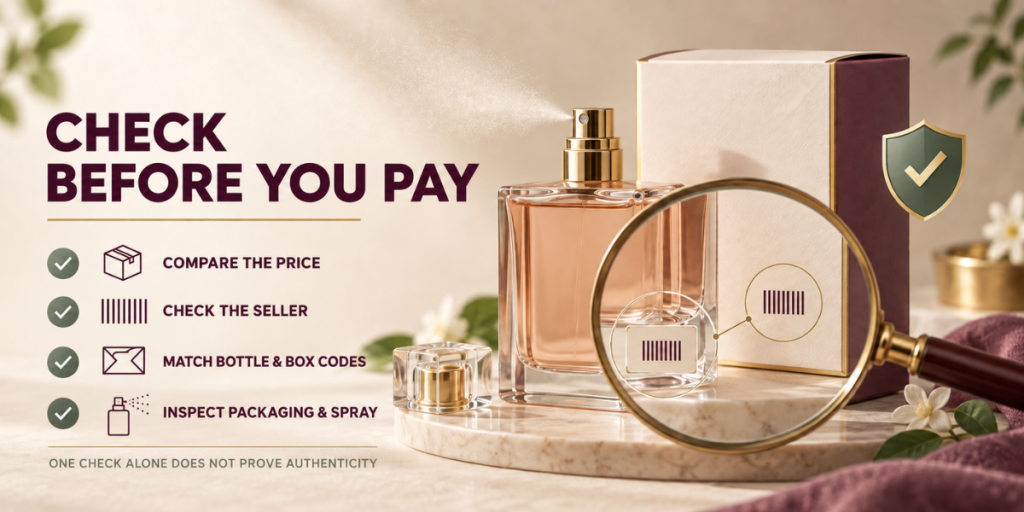
Counterfeits are the fastest way to destroy the savings you just engineered, and India’s open marketplaces are full of them.
Price is the loudest signal. An imported designer fragrance that legitimately sells for ₹25,000 or more does not appear at ₹3,000, and a well-known affordable release trading around ₹4,500 does not appear at ₹1,400. Wholesale listing sites and unbranded marketplace sellers carry these prices routinely.
Nobody is clearing genuine stock at a tenth of its value, so check what the bottle actually costs at two established retailers first and treat anything under roughly 40% of that as counterfeit, regardless of how the listing is worded.
Before you pay, watch for:
- Price well under 40% of the going rate for a current designer release.
- No batch code visible in any listing image.
- Stock photos only, with no shot of the bottle base or the box sides.
- A size the brand doesn’t officially produce. Check the brand’s own site for available volumes.
- “100% original” repeated in the listing title; genuine sellers don’t need to insist.
- A seller with no other fragrance listings, or a storefront selling perfume alongside unrelated categories
After delivery, check:
- Batch code printed rather than stickered, on both the box and the bottle base, with the two matching. Verify it on a batch-code lookup.
- Cellophane machine-tight with clean folds, not loose or hand-taped.
- Atomiser producing a fine, even mist. Wet, spitting sprays are a bad sign.
- Bottle and cap sitting flush, with clean printing and no rough seams or misaligned text.
- Longevity, as fakes are alcohol-forward on the opening and collapse inside an hour.
Safest routes: the brand’s own website, brand-operated stores on large marketplaces, established beauty retailers, and airport duty-free. For anything above ₹3,000, avoid unbranded third-party marketplace sellers entirely.
Stretch the Bottle You Own
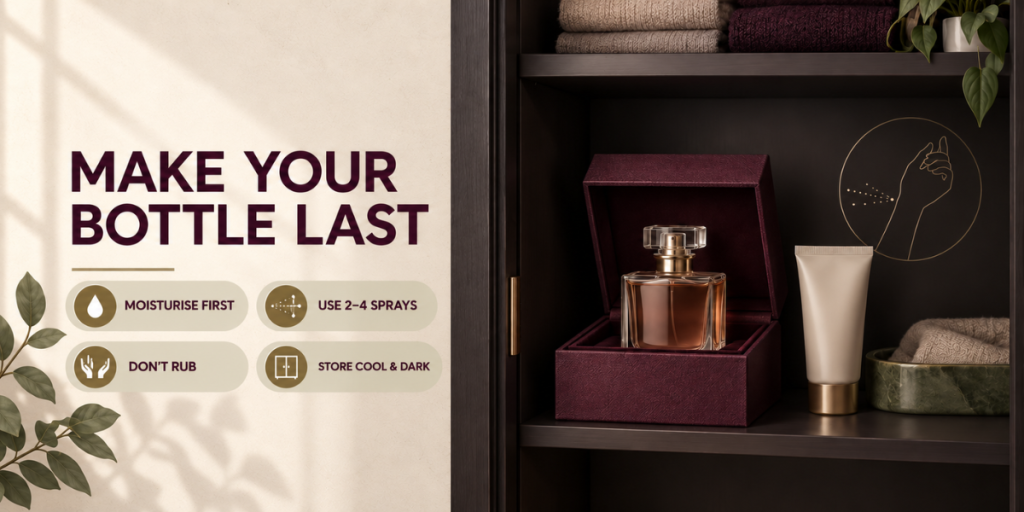
Making a bottle last twice as long is arithmetically identical to buying it at half price, and it’s the one saving available after you’ve already paid.
- Moisturise first: Fragrance binds to oil, not dry skin, which is why the same two sprays fade faster on some people than others. Unscented lotion on pulse points before spraying adds real hours; most brands’ own application guidance says to apply EDP over a moisturiser for exactly this reason.
- Spray, don’t rub: Rubbing crushes the top notes.
- Pulse points and hair: Neck, wrists, inner elbows, plus one spray on the hair, which holds scent longer than skin.
- Two to four sprays for an EDP: More doesn’t extend it.
- Store it dark and cool. Heat, sunlight and humidity degrade perfume. Boxed in a cupboard, a bottle lasts 3–5 years; on a bathroom shelf or car dashboard, it can turn inside 18 months.
- Layer with a matching body wash or deodorant where the brand offers one cheaper than extra sprays, and it holds longer.
Final Words
The single change that saves the most money here isn’t a coupon code. It’s switching the unit you shop in, from price per bottle to price per ml, and from MRP to historical average, from bank offers to cashback.
Do that, and the rest follows. You stop buying 30ml bottles that cost triple per spray, you stop treating a 50%-off banner as proof of a good price, and you start reading the concentration on the label. Add sale timing and stack the three discount layers, and a genuinely good 100ml EDP lands at a few rupees per ml.
The perfume business assumes nobody does the arithmetic. It takes ten seconds. Do it.
FAQs
How can I buy perfume for less in India?
Compare fragrances by price per ml rather than bottle price, choose EDP over EDT for better cost per wear, and buy 100ml instead of 30ml. Then stack three independent discounts: the sale price, a bank card offer, and cashback by CashKaro.
Which lasts longer, EDT or EDP?
EDP lasts longer. Eau de Parfum contains 15–20% aromatic oil and typically lasts 6–8 hours, while Eau de Toilette contains 5–15% and fades in 3–5 hours. In India’s heat and humidity, EDT fades faster still, making EDP the better value despite the higher shelf price.
Are perfume dupes legal in India?
Yes. Fragrance formulas cannot be copyrighted, so any house can legally create and sell a scent inspired by a famous original under its own name. This is completely different from a counterfeit, which illegally copies the brand name and packaging to pass itself off as the original.
Are perfume dupes worth buying?
For daily wear, yes. The opening notes are usually close to the original at 80–95% less cost. The trade-offs are a dry-down that drifts and roughly 30–50% shorter longevity.
How do I check if a perfume is original or fake?
Find the batch code, a 4–12-character alphanumeric string stamped on the bottle base and the box and confirm both match; then verify it on a batch-code checker. Check for machine-tight cellophane, a fine even mist, and price: anything under 40% of market rate is counterfeit.
When is the best time to buy perfume in India?
The festive stretch from September through Diwali brings the deepest discounts of the year, often 35–60%, followed by financial-year-end clearance in March.
Can I use a coupon and cashback on the same order?
Usually yes, since they work independently; the coupon applies at checkout while cashback is credited afterwards. Two conditions: use only coupon codes listed on the cashback site or the merchant’s site, as outside codes can void cashback, and check whether the merchant excludes app orders.